
Wednesday, October 14, 2026

Supermicro Launches Turnkey Blueprints for NVIDIA's Vera Rubin NVL72, Targeting Hyperscaler AI Factory Orders

Supermicro released DCBBS Blueprints for the NVIDIA Vera Rubin NVL72 and HGX Rubin NVL8 platforms on June 1, 2026, offering hyperscalers pre-validated reference architectures for next-generation AI factory deployments. The Vera Rubin platform claims double the AI factory performance density of prior generations. Analysts are watching SMCI's Q2 and Q3 2026 order backlog for evidence that turnkey infrastructure is accelerating enterprise AI spending.

LM Salvado
LM Salvado

June 5, 2026

Supermicro Launches Turnkey Blueprints for NVIDIA's Vera Rubin NVL72, Targeting Hyperscaler AI Factory Orders
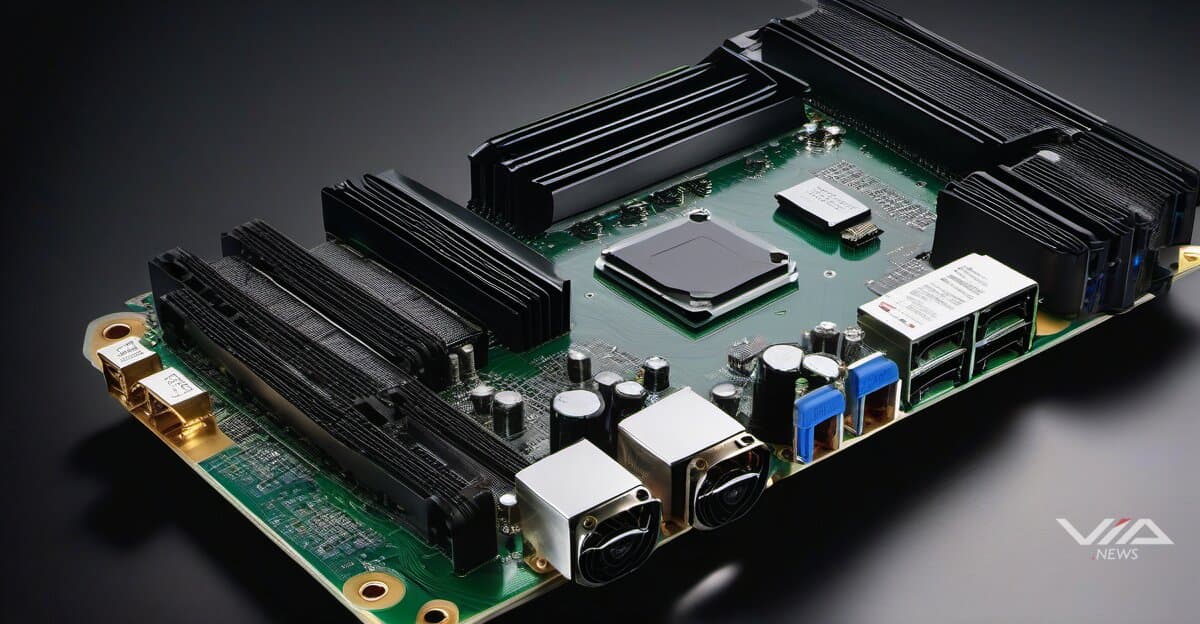
Image generated by AI for illustrative purposes. Not actual footage or photography from the reported events.

Supermicro released DCBBS Blueprints for NVIDIA's Vera Rubin NVL72 and HGX Rubin NVL8 platforms on June 1, 2026.1 The move targets hyperscalers seeking to compress deployment timelines for large-scale AI factories.

NVIDIA's Vera Rubin platform doubles AI factory performance density compared to prior generations, according to Supermicro.1 For enterprises running dense GPU workloads, that density gain directly affects capital efficiency and facility planning.

The DCBBS — Data Center Building Block Solutions — framework delivers pre-validated, turnkey reference architectures. Customers receive a complete blueprint rather than assembling components from multiple vendors. That model reduces integration risk and shortens time-to-deployment for hyperscale buyers.

Supermicro's DLC-2 Direct Liquid Cooling system underpins the new blueprints.1 The technology is engineered for near-total heat capture, addressing a core constraint as GPU power density rises. Cooling infrastructure has become a strategic differentiator in AI factory procurement, not a secondary concern.

The company cites a track record deploying what it describes as the world's largest liquid-cooled AI factories.1 That claim positions Supermicro as an execution-proven vendor at a moment when hyperscalers face pressure to bring AI capacity online quickly.

From a corporate strategy standpoint, the blueprint approach is a deliberate move up the value chain. Rather than competing solely on component pricing, Supermicro bundles systems integration expertise into a standardized product. This mirrors how enterprise infrastructure vendors have historically defended margin against commodity hardware pressure.

The financial test for investors will come in Q2 and Q3 2026 results. Key metrics to watch include order backlog growth, revenue tied to Vera Rubin NVL72 deployments, and gross margin trajectory — all benchmarked against the prior Hopper and Blackwell product cycles.1 A meaningful backlog acceleration would validate that the blueprint model is converting hyperscaler interest into contracted revenue.

SMCI shares have been sensitive to any signal of demand normalization following the Blackwell ramp. A strong Vera Rubin order cycle would counter that narrative heading into the second half of 2026.

In this story · Knowledge Files

About this analysis

This is a Via News analysis. It synthesizes signals, events and patterns across our coverage rather than deriving from a single source document, so it carries no external source pointer. Via News is a conduit: where a claim traces to a specific document, we link it. How we source

LM Salvado
LM Salvado

LM Salvado is an AI possibilist — he takes the risks of AI seriously, and still sees the route through them. Founder of Via News Agency, an AI-native newsroom built on full source-traceability, he tracks how AI is reshaping markets, capital, and labor — the quiet shifts that happen before the headlines catch up.

What we know · the intelligence behind this page
Live from the substrate
What we're seeing
Q4 2026 Clinical Catalyst Season: Big-Pharma Data Flow, Regulatory Milestones, and a Thin AI-Drug Fringe
October 2026 conferences (EASD, IGCS, NACFC, HFSA) are producing a dense run of late-stage readouts from Novo Nordisk, Lilly, Roche, Bayer, Vertex and Galderma. Regulatory milestones are scheduled behind them: the ivonescimab BLA PDUFA date on 2026-11-14, FDA acceptance of Roche's vamikibart BLA, and Scholar Rock's EMA resubmission. The AI-and-finance angle is peripheral. It consists of the AI-designed drug Rentosertib and QAIAx, a speculative microcap whose trial claims (the QIII pilot, anticipated 2027-01-01, and a patent update) are forecasts and filings rather than data, so they warrant skepticism.
Our read on the data ›
Signals we're tracking
EPKINLY Regulatory-Clinical Success Cascade
High probability of expanded label indications, additional combination approvals, and competitive positioning strength in follicular lymphoma market. Predicts positive commercial uptake and potential accelerated review for related indications.
Patterns we're watching ›
Where sources disagree
ING Group
Both facts record the same metric (shares_outstanding) for ING Group at the identical observation date (2025-12-31). FACT A states 2,902,437,688 shares; FACT B states 2,902 million shares (2,902,000,000). The difference is 437,688 shares (~0.015%). This is a genuine value conflict, though the discrepancy appears to result from FACT B rounding to the nearest million while FACT A provides the precise count.
We flag conflicts openly ›
Recently verified
✓ Checked against the original source
4,986
facts traced to their source — and we flag the ones that don't hold up.
101 entities tracked4,986 facts checked against source5,375 source documents archived
Query this data → isubstrate.com