
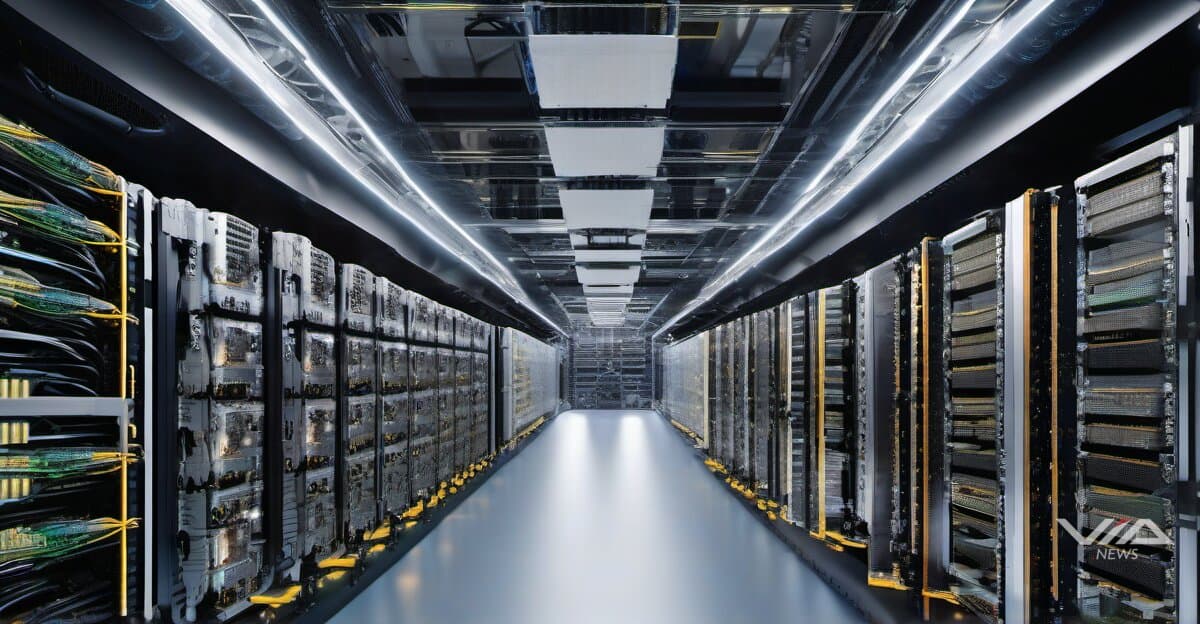
Enterprise AI adoption is driving unprecedented capital deployment across the semiconductor and data center infrastructure stack, as chipmakers, memory suppliers, and connectivity providers race to capture share of a market projected to balloon from $43.7 billion to more than $323 billion by decade's end.
The infrastructure buildout spans multiple critical layers—advanced semiconductors, high-bandwidth memory, data center interconnects, and edge computing capacity—reflecting the capital-intensive requirements of training and deploying large-scale AI models. Hyperscalers and enterprise customers are fueling sustained investment cycles that industry observers characterize as a generational infrastructure upgrade.
Semiconductor Suppliers Issue Bullish Forecasts
Credo Technology Group, a key player in high-speed connectivity solutions for data centers, is projecting GAAP gross margins between 63.8% and 65.8% for Q3 fiscal 2026, signaling robust pricing power amid strong demand. The company's margin guidance reflects the premium economics available to suppliers of specialized AI infrastructure components.
Meanwhile, Aehr Test Systems is experiencing a significant uptick in orders for its advanced semiconductor testing platforms. The company reported $5.5 million in Sonoma system orders during Q3 fiscal 2026 alone—exceeding the entire prior quarter's total. More significantly, Aehr's lead production customer provided what management described as a "very large forecast" for AI ASIC testing equipment, with initial shipments expected to commence in Q1 fiscal 2027 beginning May 30, 2026.
Aehr's second-half fiscal 2026 guidance calls for $60 million to $80 million in bookings, predominantly driven by AI wafer-level and packaged-part burn-in testing equipment. The company's expanded partnership with ISE Labs and ASE—the world's leading outsourced semiconductor assembly and test (OSAT) platform—positions it to serve top-tier semiconductor customers developing high-performance computing and AI applications.
Memory Wall and Packaging Define Next Competitive Frontier
Industry analysts point to bottlenecks around the "memory wall"—the bandwidth limitations between processors and memory—and advanced packaging technology as defining constraints for next-generation AI systems. High-bandwidth memory (HBM) and novel packaging approaches like chiplet architectures are becoming critical differentiators as AI workloads demand exponentially greater data throughput.
Google Custom Silicon Strategy Targets Nvidia Dominance
The competitive landscape is evolving beyond Nvidia's current market leadership. Google's expanded investment in custom silicon development—including tensor processing units (TPUs) and AI accelerators—signals that hyperscalers are pursuing vertical integration to optimize performance and economics for their specific AI workloads. This maturing ecosystem suggests differentiation opportunities for specialized suppliers across the stack, from custom ASICs to power delivery and thermal management solutions.
The confluence of improving sentiment trajectories, expanding production capacity, and multi-year visibility on enterprise AI deployment timelines underpins the bullish outlook across AI infrastructure suppliers. For investors and strategic planners, the capital intensity and long deployment cycles characteristic of semiconductor and data center infrastructure suggest a sustained investment theme extending well beyond current market cycles.