
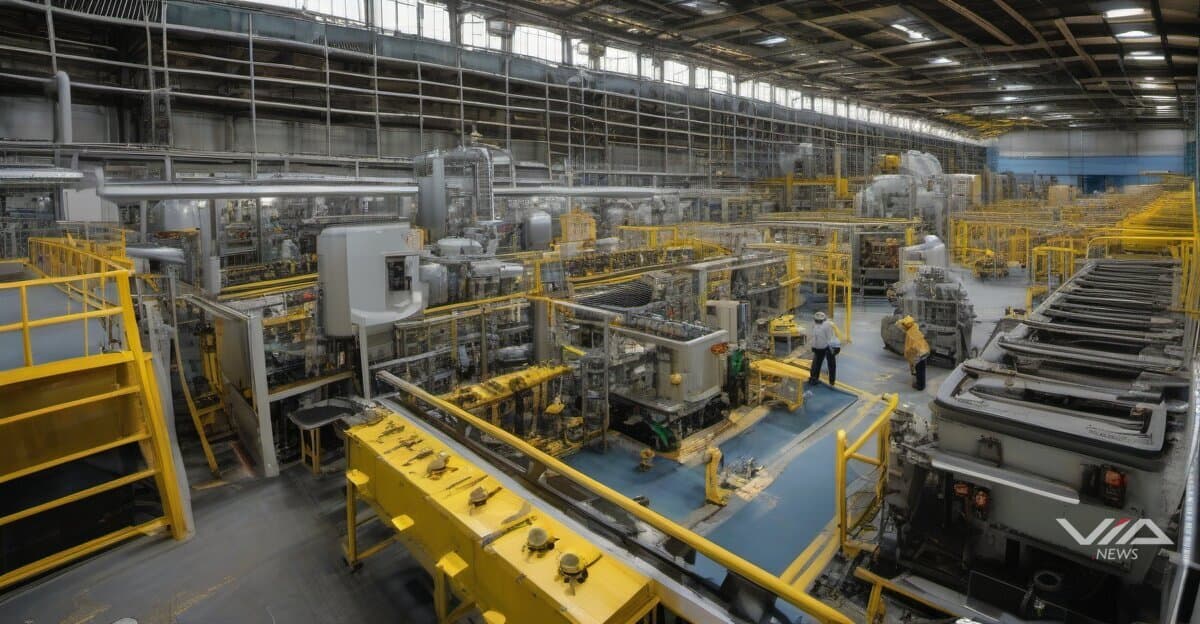
When ProLogium Technology inaugurated what it calls the world's first giga-level solid-state battery factory in Taoyuan, Taiwan, the milestone was celebrated across the electric vehicle industry as proof that next-generation energy storage had crossed from laboratory promise into industrial reality. For financial analysts, the opening marked something else: the crystallization of a concentrated geopolitical risk exposure that is now embedded in the supply chains of every carmaker and technology company with a strategic interest in solid-state batteries.
The Taoyuan facility represents a substantial concentration of proprietary manufacturing capital — equipment, intellectual property, and process know-how — in a jurisdiction that risk modelers increasingly flag as subject to potential disruption scenarios ranging from export control escalation to kinetic conflict. Geopolitical risk assessments reviewed by Finance Via News classify the cross-strait exposure of Taiwan-based advanced manufacturing as carrying a catastrophic severity rating, with a medium likelihood of material disruption over a five-to-ten-year investment horizon and a confidence weighting of 0.7 — a level that typically triggers formal review in institutional risk frameworks.
That combination — catastrophic downside, non-trivial probability — is forcing a rethink in how corporate treasuries and infrastructure funds model their battery supply chain investments. "The question is no longer whether Taiwan risk exists," said one European fund manager familiar with battery sector exposure. "The question is how to price it, and whether you can diversify around it when the most advanced manufacturing is concentrated there."
ProLogium's predicament is an acute version of a broader structural problem. Taiwan hosts not only leading semiconductor fabs but is now emerging as a node for advanced materials manufacturing, including solid-state electrolyte production. Unlike conventional lithium-ion cells, where manufacturing capacity has been broadly distributed across China, South Korea, and increasingly Europe and North America, solid-state battery production at scale remains nascent and geographically narrow. ProLogium's Taoyuan gigafactory is, by most industry accounts, the only facility currently operating at giga-level for solid-state cells — making it simultaneously a benchmark achievement and a single point of failure for a global supply chain.
The corporate investment implications are significant. Automakers that have signed offtake agreements or strategic partnerships contingent on ProLogium's production ramp must now incorporate scenario planning for supply interruption. Export control risk is particularly salient: tightening restrictions on advanced manufacturing equipment or materials moving through Taiwan-adjacent trade corridors could constrain output independent of any military scenario. The U.S. CHIPS and Science Act framework, and parallel European battery sovereignty initiatives, have demonstrated that technology-linked export controls can move quickly when geopolitical conditions shift.
For investors, the calculus points toward geographic diversification as a prerequisite for bankable battery supply chain projects. ProLogium itself has announced plans for a European gigafactory in Dunkirk, France, a facility that would replicate solid-state production capacity in a jurisdiction outside cross-strait risk parameters. The pace and funding of that buildout will be watched closely as a signal of how seriously the company — and its backers — are treating the Taiwan concentration risk.
The broader lesson for financial decision-makers is structural: as advanced manufacturing becomes the defining variable in the energy transition, geopolitical risk management can no longer be treated as a compliance function. It is becoming a core input into capital allocation, project finance underwriting, and strategic partnership valuation. ProLogium's Taoyuan factory is, for now, the leading edge of that reality.