
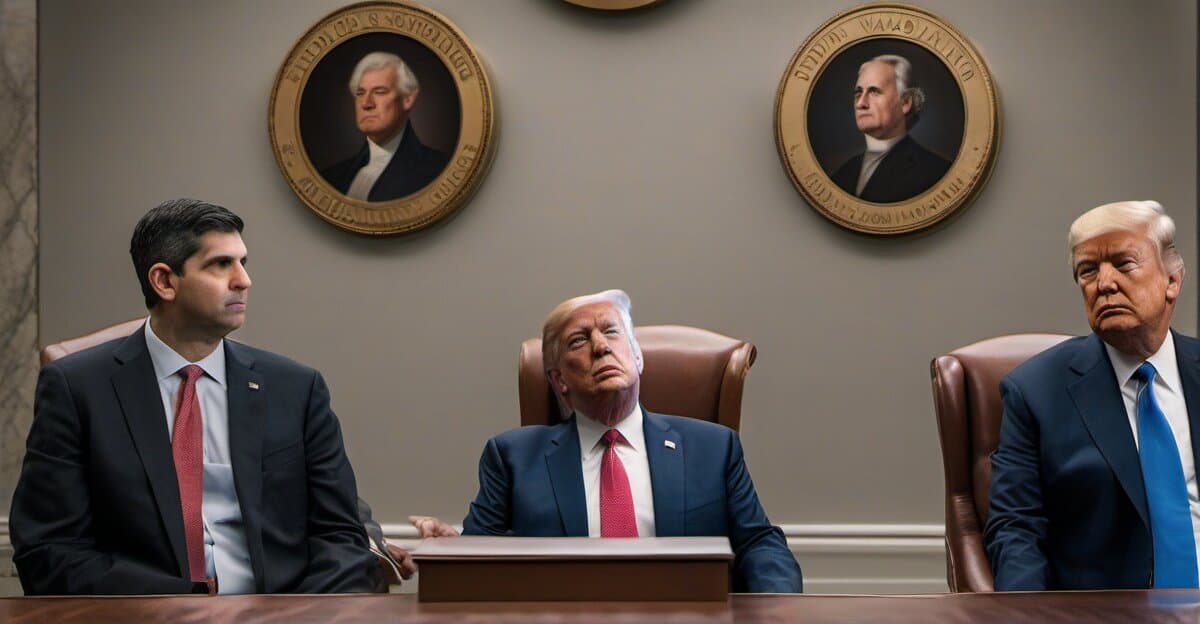
Wall Street is recalibrating. With Trump's reported nomination of Kevin Warsh to replace Jerome Powell as Federal Reserve Chair, financial markets face their most consequential leadership transition at the central bank in over a decade — and the downstream effects are already visible across equities, commodities, and the fintech sector.
Warsh, a former Fed governor known for his skepticism toward prolonged accommodation and his alignment with market-disciplined monetary policy, would represent a meaningful philosophical shift from Powell's data-dependent gradualism. The transition introduces uncertainty at a moment when the Fed is still navigating stubborn core inflation, a resilient labor market, and the emerging productivity implications of AI-driven infrastructure investment.
Markets Price in a New Regime
The early market reaction reflects investor rotation rather than panic. SoFi surged approximately 5% as fintech investors bet that a more hawkish-leaning Fed chair would accelerate deregulatory momentum and reward higher-yielding, rate-sensitive consumer lending models. Meanwhile, silver tumbled roughly 25% and gold broke below the $5,000 threshold — a sharp reversal for traditional inflation hedges that signals growing confidence, at least in the short term, that the monetary tightening cycle is closer to resolution than escalation.
That rotation also has a technology dimension. Intel's acquisition of SambaNova Systems — a move that consolidates AI inference infrastructure under a major semiconductor umbrella — is being read as a confirmation that AI productivity gains will increasingly factor into forward-looking monetary assessments. If AI-driven efficiency genuinely compresses inflation over the medium term, a Warsh-led Fed might find itself with more room to ease than current projections suggest.
Global Central Banks Offer a Counterpoint
The domestic uncertainty is unfolding against a backdrop of deliberate steadiness abroad. The Bank of Canada held its benchmark rate at 2.25% at its most recent meeting, with Governor Tiff Macklem describing that level as "about the right level" provided that economic and inflation forecasts materialize. With Canada's headline inflation running at 2.4% and core measures averaging 3.15%, the Bank sees enough containment to prioritize support for a tariff-pressured economy without further accommodation.
In Japan, the Bank of Japan's disclosure that life insurance reserves account for 21% of total household financial assets underscores how differently monetary policy transmission operates across jurisdictions — and how a shift in U.S. rate expectations ripples through global portfolio positioning, particularly for yen-denominated assets.
What This Means for Banking and Fintech
For U.S. banks, the Warsh scenario cuts both ways. A more hawkish posture could sustain net interest margins longer than the market had previously priced in, benefiting traditional lenders. But a more unpredictable policy path — shaped by a chair navigating political expectations alongside economic data — raises operational planning risk for institutions that have structured their balance sheets around the Powell-era cadence.
Fintech firms, particularly those in consumer lending and embedded finance, are arguably better positioned to adapt. Their variable-rate product structures and technology-driven cost bases allow faster repricing. The 5% SoFi move suggests markets agree.
The core tension remains: a Fed leadership transition doesn't change the underlying inflation arithmetic, but it does change how credibly markets can anchor their rate expectations. For finance professionals, that uncertainty premium is now a live variable in every pricing model on the desk.