
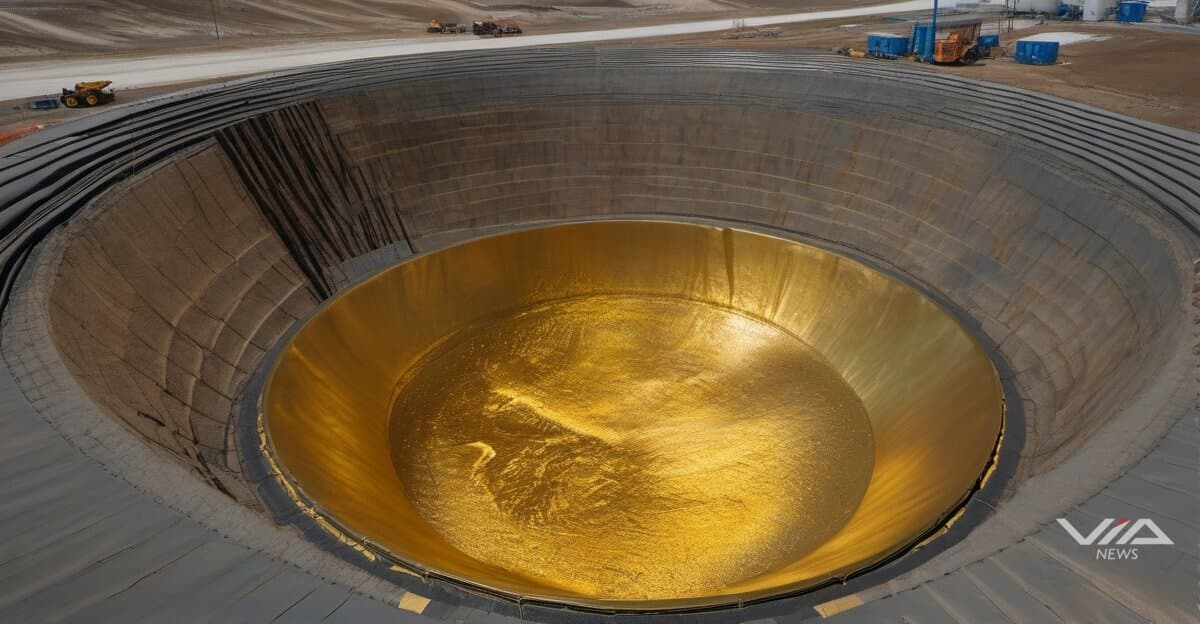
Artemis Gold Inc. (TSXV: ARTG, OTCQX: ARGTF) has approved one of Canada's most ambitious self-funded mine expansions, committing $1.44 billion CAD to scale its Blackwater Mine in central British Columbia from an emerging producer into a top-tier North American gold operation.
The Expanded Phase 2 (EP2) plan, sanctioned by the board on December 15, 2025, is designed to lift processing capacity toward 21.9 million tonnes per annum — the ceiling allowed under existing federal and provincial Environmental Assessment Certificates. Early works are scheduled to begin in January 2026, with major construction launching in Q3 2026 and the first gold pour from EP2 facilities expected in Q3 2028.
Financing Structure: Operating Cash Flow as the Engine
The most consequential corporate finance decision embedded in the EP2 plan is its funding model. Artemis intends to finance the expansion primarily from the cash generated by Phase 1 operations — a structure that avoids dilutive equity raises or heavy debt loading, but places significant demands on near-term operational performance.
That calculation looks favorable at current gold prices. With spot gold at approximately US$4,200 per ounce as of mid-December 2025 and an all-in sustaining cost (AISC) of US$825–875 per ounce in 2025, Artemis is generating margins exceeding US$3,000 per ounce — a 75% margin on revenue. The company's 2025 production guidance of 190,000–210,000 ounces of gold and 600,000–1,200,000 ounces of silver implies substantial free cash flow generation if those margins hold.
Capital intensity for EP2 is estimated at C$110 per tonne of additional annual throughput — a figure management has positioned as competitive within the global bulk open-pit mining peer group. Phase 1A, a smaller preparatory capital package, is valued at $110 million and is reported to be tracking within budget.
Production Ramp and Revenue Trajectory
The production profile across the expansion period is substantial. During the 2026–2028 construction phase, gold output is projected at 275,000–425,000 ounces annually, with 2026 expected at the lower end of that range as the transition ramps up. Once EP2 reaches full production — targeted by end of 2028 — the mine is forecast to produce 500,000–525,000 ounces of gold and 2,000,000–2,500,000 ounces of silver per year through 2034, equating to roughly 520,000–550,000 gold equivalent ounces annually.
The mine's reserve base supports a production timeline extending to 2043. Total proven and probable reserves stand at 334.3 million tonnes grading 0.75 g/t gold and 5.8 g/t silver, containing 8.0 million ounces of gold and 62.2 million ounces of silver. The broader measured and indicated resource base of 596.8 million tonnes offers additional upside, with 75% already in the higher-confidence measured category.
Key Remaining Risks
The EP2 investment carries a formal conditionality: Artemis has indicated the expansion is contingent on formal confirmation from BC Hydro regarding hydropower supply, expected in early 2026. The operation's green energy credentials — powered by BC Hydro's hydroelectric grid — are a differentiating ESG factor for institutional investors increasingly focused on emissions intensity in mining portfolios.
Equipment procurement is already advanced. An 18 MW SAG mill and an 18 MW ball mill were ordered in September 2025; the ball mill was reportedly acquired from a cancelled order, expediting the supply chain. Mine's Act permit alignment — required before full-scale EP2 construction — is anticipated during 2026.
At a peak mining rate of 90–95 million tonnes per annum and AISC in the US$1,000–1,100 per ounce range through the mature production years, Blackwater's long-term economics depend heavily on where gold prices settle. At today's prices, the margin buffer is substantial. The degree to which that cushion persists will determine whether Artemis's self-funded growth thesis delivers the shareholder value its capital structure is designed to protect.