
Thursday, October 15, 2026

Nine-Sector GTC Taipei Partnership Cluster Points to NVIDIA Data Center Revenue Acceleration in Q3-Q4 2026

Nine companies across six verticals announced NVIDIA partnerships at GTC Taipei within a 48-hour window on June 7, 2026. Historical precedent links this cluster pattern to NVIDIA quarterly revenue beats one to two quarters later. The sector breadth — spanning creative tools, EDA, finance, security, and enterprise AI — reduces single-use-case concentration risk.

LM Salvado
LM Salvado

June 8, 2026

Nine-Sector GTC Taipei Partnership Cluster Points to NVIDIA Data Center Revenue Acceleration in Q3-Q4 2026
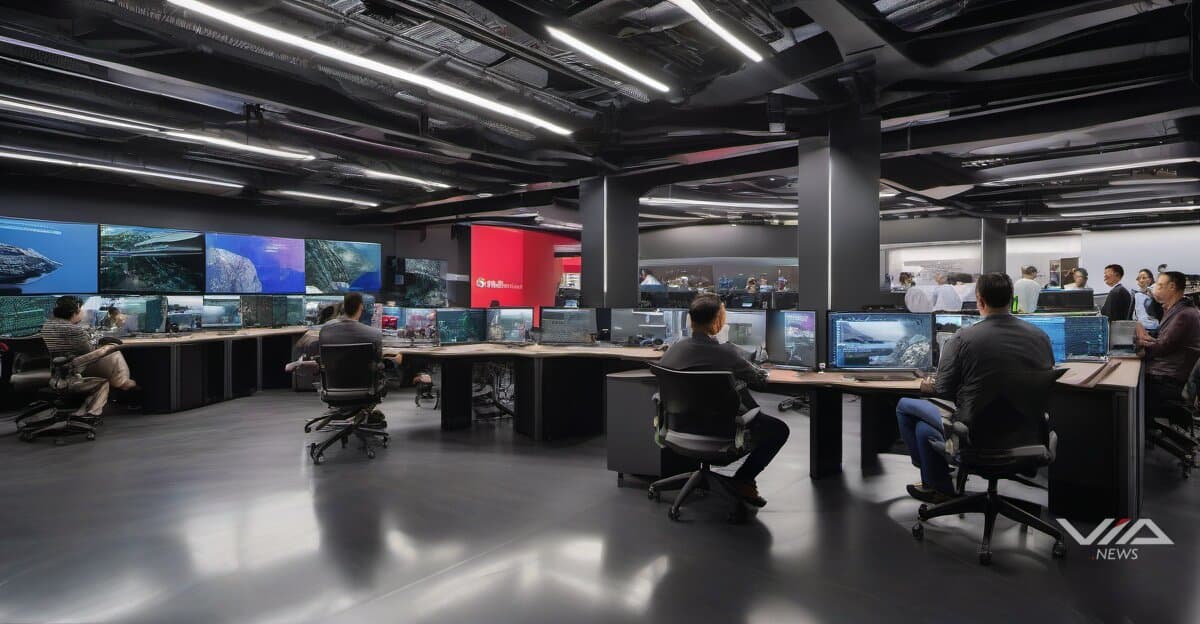
Image generated by AI for illustrative purposes. Not actual footage or photography from the reported events.

Nine companies announced partnerships with NVIDIA at GTC Taipei within a 48-hour window on June 7, 2026.1 Historical precedent links this type of multi-sector cluster to NVIDIA quarterly revenue beats by one to two quarters.

The partner list: Adobe, Microsoft, Canonical, Red Hat, Cadence, Siemens, Synopsys, NYSE, CrowdStrike, and Palantir.1 Together they span creative software, enterprise cloud, Linux infrastructure, electronic design automation (EDA), financial exchange, cybersecurity, and data analytics.

Why Cluster Timing Signals Revenue

GTC partnership agreements convert into hardware procurement cycles. Partners integrating NVIDIA platforms into their own products require accelerated compute infrastructure — translating to data center GPU orders.

The 48-hour window is not coincidental.1 Simultaneous multi-sector announcements reflect coordinated go-to-market alignment that typically follows hardware commitment negotiations, not preliminary talks.

Sector Breadth as a Risk Hedge

Single-sector clusters carry concentration risk. The GTC Taipei cluster covers at least six distinct verticals, each with structurally different GPU workloads.1

NYSE's inclusion is notable. Financial exchange infrastructure demands extreme throughput and latency optimization. An exchange-level partnership signals GPU adoption moving from analytics into core trading and settlement infrastructure.

Siemens, Cadence, and Synopsys represent EDA — chip and industrial simulation workloads that differ entirely from generative AI inference. CrowdStrike adds security processing. Palantir covers government and enterprise analytics.

Four structurally different GPU workload types are represented: inference at scale, physical simulation, security processing, and creative AI generation.1 One or two verticals slowing would not eliminate aggregate demand growth.

Q3-Q4 2026 Outlook

The signal points to data center revenue acceleration in Q3-Q4 2026.1 Partners converting GTC Taipei agreements into purchase orders flow through NVIDIA's data center segment — already the dominant revenue driver.

The conversion lag is one to two quarters. Q3 2026 earnings, reporting in August, represent the earliest confirmation point. Q4 2026 reporting in November would be the fuller signal.

Investors tracking this thesis should watch NVIDIA's data center segment revenue as the primary metric. Broad vertical uptake, if confirmed, would support sustained revenue growth rather than a single-use-case plateau.

In this story · Knowledge Files

About this analysis

This is a Via News analysis. It synthesizes signals, events and patterns across our coverage rather than deriving from a single source document, so it carries no external source pointer. Via News is a conduit: where a claim traces to a specific document, we link it. How we source

LM Salvado
LM Salvado

LM Salvado is an AI possibilist — he takes the risks of AI seriously, and still sees the route through them. Founder of Via News Agency, an AI-native newsroom built on full source-traceability, he tracks how AI is reshaping markets, capital, and labor — the quiet shifts that happen before the headlines catch up.

What we know · the intelligence behind this page
Live from the substrate
What we're seeing
Q4 2026 Clinical Catalyst Season: Big-Pharma Data Flow, Regulatory Milestones, and a Thin AI-Drug Fringe
October 2026 conferences (EASD, IGCS, NACFC, HFSA) are producing a dense run of late-stage readouts from Novo Nordisk, Lilly, Roche, Bayer, Vertex and Galderma. Regulatory milestones are scheduled behind them: the ivonescimab BLA PDUFA date on 2026-11-14, FDA acceptance of Roche's vamikibart BLA, and Scholar Rock's EMA resubmission. The AI-and-finance angle is peripheral. It consists of the AI-designed drug Rentosertib and QAIAx, a speculative microcap whose trial claims (the QIII pilot, anticipated 2027-01-01, and a patent update) are forecasts and filings rather than data, so they warrant skepticism.
Our read on the data ›
Signals we're tracking
EPKINLY Regulatory-Clinical Success Cascade
High probability of expanded label indications, additional combination approvals, and competitive positioning strength in follicular lymphoma market. Predicts positive commercial uptake and potential accelerated review for related indications.
Patterns we're watching ›
Where sources disagree
ING Group
Both facts record the same metric (shares_outstanding) for ING Group at the identical observation date (2025-12-31). FACT A states 2,902,437,688 shares; FACT B states 2,902 million shares (2,902,000,000). The difference is 437,688 shares (~0.015%). This is a genuine value conflict, though the discrepancy appears to result from FACT B rounding to the nearest million while FACT A provides the precise count.
We flag conflicts openly ›
Recently verified
✓ Checked against the original source
4,986
facts traced to their source — and we flag the ones that don't hold up.
101 entities tracked4,986 facts checked against source5,375 source documents archived
Query this data → isubstrate.com