
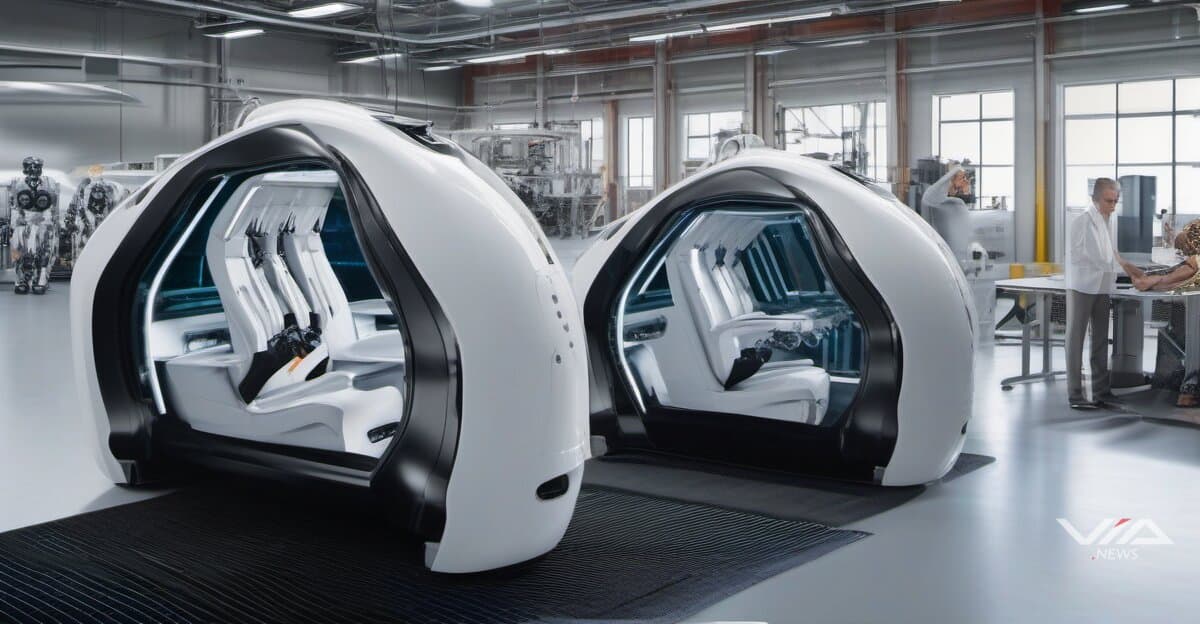
Robotaxis will launch in 2026, with commercial autonomous vehicle production following in 2028, marking the robotics industry's shift from pilot programs to market-scale manufacturing.
Mobileye acquired Mentee Robotics to accelerate humanoid robot development, with Prof. Lior Wolf stating the deal provides "access to unparalleled AI infrastructure and commercialization expertise" for scalable humanoid solutions. The acquisition follows Boston Dynamics' transition of its Atlas platform from research to enterprise deployment.
The 2026-2028 timeline creates an investment window for companies positioning themselves before mass production begins. Industrial automation firms are developing fully autonomous manufacturing systems, while service robotics companies expand into delivery robots, robotic vacuum cleaners, and medical exoskeletons.
Regulatory approvals and insurance coverage are expanding access to assistive robotics, particularly in healthcare applications. Xiangyi Cheng, working on AR applications for medical settings, noted that "everyone's hand is different, so the surgery should be personalized," highlighting the customization requirements driving robotic precision in medical procedures.
Boston Dynamics engineers conducted final testing of Atlas research platform's "full-body control and mobility limits" as the enterprise version deployed to commercial customers. This parallel development approach—maintaining research platforms while scaling enterprise solutions—appears standard across the industry.
The multi-domain expansion spans autonomous vehicles, industrial automation, and service robots simultaneously. Companies must balance R&D investment with production scaling over the next 24-36 months.
Mathematical and engineering foundations remain critical as the industry scales. Cheng advises aspiring roboticists to "focus on mathematics" because "it's the foundation behind everything" in engineering, even as robotics appears hands-on.
Investment opportunities concentrate in three areas: autonomous vehicle technology reaching production milestones, industrial automation companies building fully autonomous manufacturing systems, and service robotics firms securing regulatory approvals for market expansion. The 2026-2028 production timeline gives companies a defined window to establish manufacturing capacity and distribution networks before competitors reach market scale.