
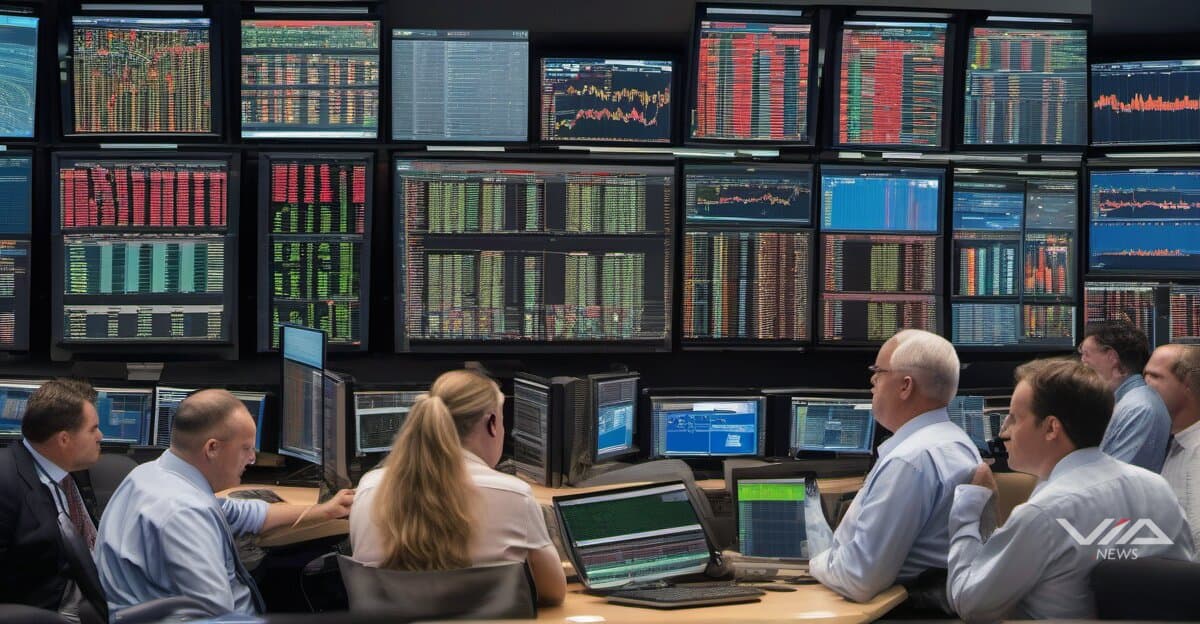
The promise of artificial intelligence in financial markets has never sounded more egalitarian. Platforms with names like Vorexlan, Quantum AI, GPT Invest, and Lucren have spent the past year flooding digital channels with the message that sophisticated algorithmic trading — once the exclusive domain of hedge funds and proprietary trading desks — is now available to anyone with a $250 deposit and an internet connection.
The reality, as 2026 begins to take shape, is considerably more complicated.
Institutions Pull Further Ahead
At the professional end of the spectrum, firms like Flow Traders and Virtu Financial reported strong 2025 performance, underpinned by years of investment in proprietary deep learning systems, co-located infrastructure, and quant talent pipelines. Their edge is not simply technological — it is structural. These firms operate with direct market access, microsecond execution speeds, and risk management frameworks refined over decades, tracing intellectual lineage back to the mathematical rigor pioneered by Renaissance Technologies.
Virtu Financial, for example, has consistently leveraged high-frequency strategies across thousands of instruments globally, while Flow Traders has expanded its volatility-linked ETF operations. Both firms benefit from regulatory transparency obligations — including formal position disclosures in UK markets — that impose discipline and institutional credibility on their operations.
The Retail AI Boom: Accessibility With Asterisks
The consumer-facing tier tells a different story. Platforms like Vorexlan, which launched in 2025 and operates out of Milan, present multi-layer neural network models, real-time sentiment analysis, and anomaly detection as accessible tools for retail investors. Vorexlan's stated business model is worth examining closely: the company describes itself as a services firm that earns revenue through relationships with partnered brokers, explicitly noting it does not gain or lose money based on user trading outcomes. Users are connected to third-party regulated brokers who handle execution, fund custody, and compliance.
The minimum deposit threshold sits at $250 — low enough to attract broad participation, high enough to represent meaningful risk for retail participants unfamiliar with automated trading dynamics. Disclaimers across these platforms routinely warn that past performance does not guarantee future results, that trading involves substantial risk, and that users may lose their entire investment.
That tension — between bold marketing and boilerplate risk warnings — defines the retail AI trading boom. The claims are compelling: real-time global data feeds, high-frequency integration, algorithm-driven positioning, and adaptive strategies that refine themselves on live market data. The underlying question of whether these systems genuinely deliver alpha, or merely simulate the aesthetics of institutional-grade trading, remains largely unanswered for retail users who lack the tools to independently verify performance.
Regulatory Pressure Builds
Regulators are beginning to pay attention. Disclosure requirements in UK markets have tightened position reporting obligations, and consumer protection frameworks across the EU are increasingly scrutinizing fintech platforms that market automated systems to retail audiences. The asymmetry of sophistication between platform operators and end users is precisely the kind of structural imbalance that draws regulatory focus.
For investors navigating this landscape, the bifurcation carries a practical lesson: institutional algorithmic trading has matured into a rigorous, capital-intensive discipline where barriers to entry are high and results are auditable. The retail AI trading ecosystem, by contrast, remains a space of genuine uncertainty — where technology marketing often outpaces verifiable performance data, and where due diligence falls squarely on the individual investor.
The democratization of trading tools is real. Whether it translates into democratized returns remains the defining question of this moment in fintech.