
Thursday, October 15, 2026

NYSE Rebuilds Market Infrastructure on NVIDIA Silicon and Redpanda Streaming

NYSE is partnering with NVIDIA, HPE, and Redpanda to overhaul its market infrastructure using AI-optimized chips and high-throughput data pipelines. The shift is expected to accelerate industry-wide capital expenditure on AI-native infrastructure in H2 2026. Legacy vendors including Broadridge, SS&C, and FIS face competitive pressure as exchanges modernize in-house.

LM Salvado
LM Salvado

June 7, 2026

NYSE Rebuilds Market Infrastructure on NVIDIA Silicon and Redpanda Streaming
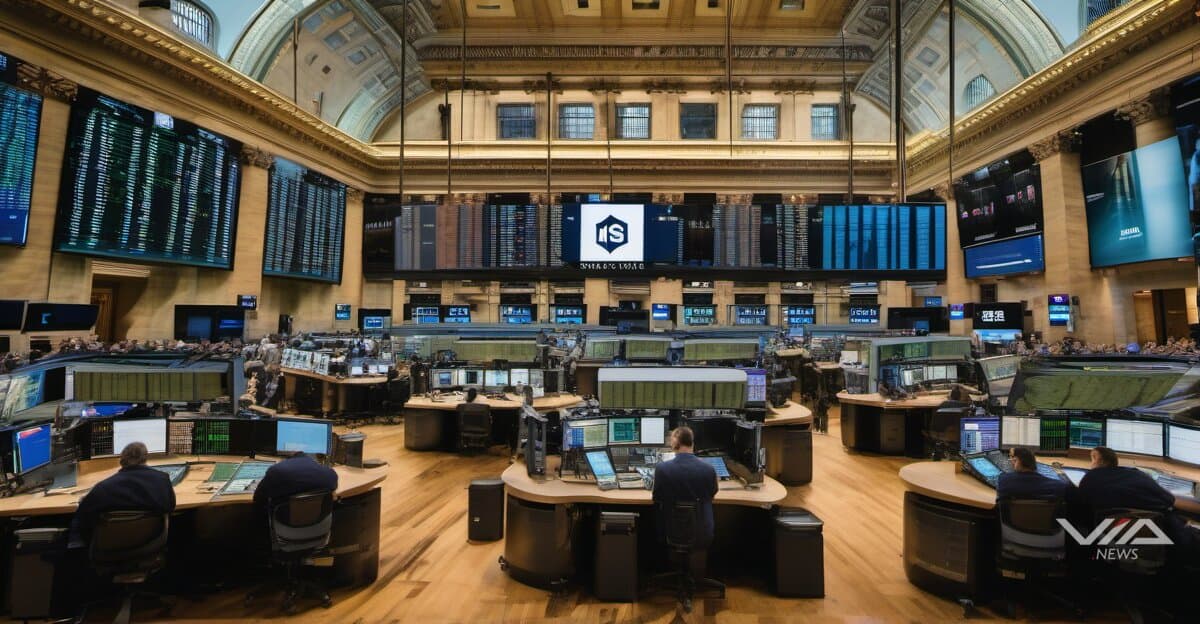
Image generated by AI for illustrative purposes. Not actual footage or photography from the reported events.

NYSE is partnering with NVIDIA, HPE, and Redpanda to rebuild its market infrastructure on AI-optimized silicon and high-throughput streaming.1

NVIDIA's Vera CPU and BlueField-4 STX data processing unit form the hardware core of the new stack.1 The BlueField-4 STX offloads networking and security tasks from the main CPU. That frees compute resources for inference workloads running alongside real-time trading operations.

HPE provides the server infrastructure layer. Redpanda handles data pipelines — a Kafka-compatible streaming platform built for financial data workloads.1 Kafka compatibility preserves existing application integrations. Exchanges can migrate without rewriting upstream systems.

The stack is a direct challenge to legacy market data vendors. Broadridge, SS&C, and FIS built their platforms on older infrastructure.1 As exchanges move workloads in-house onto purpose-built silicon, third-party middleware loses relevance. Margin pressure follows.

Financial exchanges are projected to accelerate capital expenditure on AI-native infrastructure in H2 2026.1 NVIDIA's data center segment benefits directly. Each exchange modernization cycle generates server, DPU, and networking spend.

The performance gap between old and new stacks is structural. Legacy market data systems were designed for throughput — moving bytes fast. AI-native stacks run inference at wire speed — deriving signals from data as it arrives. That gap widens as trading strategies incorporate more real-time AI.

NYSE's stack choice functions as a reference architecture. When the world's largest equity exchange standardizes on a vendor combination, smaller exchanges, clearinghouses, and market operators pay attention. Technology adoption in financial infrastructure tends to follow the largest operators.

For institutional investors, the build-out creates a durable capital allocation theme. NVIDIA data center revenue gains a financial services vertical alongside cloud hyperscalers. HPE captures server refresh cycles. Redpanda competes for streaming contracts previously held by legacy messaging vendors.

The displacement risk for Broadridge, SS&C, and FIS is contract-level for now. But exchanges building AI-native stacks in-house reduce long-term dependency on managed services. That structural shift compounds over time.

In this story · Knowledge Files

About this analysis

This is a Via News analysis. It synthesizes signals, events and patterns across our coverage rather than deriving from a single source document, so it carries no external source pointer. Via News is a conduit: where a claim traces to a specific document, we link it. How we source

LM Salvado
LM Salvado

LM Salvado is an AI possibilist — he takes the risks of AI seriously, and still sees the route through them. Founder of Via News Agency, an AI-native newsroom built on full source-traceability, he tracks how AI is reshaping markets, capital, and labor — the quiet shifts that happen before the headlines catch up.

What we know · the intelligence behind this page
Live from the substrate
What we're seeing
Q4 2026 Clinical Catalyst Season: Big-Pharma Data Flow, Regulatory Milestones, and a Thin AI-Drug Fringe
October 2026 conferences (EASD, IGCS, NACFC, HFSA) are producing a dense run of late-stage readouts from Novo Nordisk, Lilly, Roche, Bayer, Vertex and Galderma. Regulatory milestones are scheduled behind them: the ivonescimab BLA PDUFA date on 2026-11-14, FDA acceptance of Roche's vamikibart BLA, and Scholar Rock's EMA resubmission. The AI-and-finance angle is peripheral. It consists of the AI-designed drug Rentosertib and QAIAx, a speculative microcap whose trial claims (the QIII pilot, anticipated 2027-01-01, and a patent update) are forecasts and filings rather than data, so they warrant skepticism.
Our read on the data ›
Signals we're tracking
EPKINLY Regulatory-Clinical Success Cascade
High probability of expanded label indications, additional combination approvals, and competitive positioning strength in follicular lymphoma market. Predicts positive commercial uptake and potential accelerated review for related indications.
Patterns we're watching ›
Where sources disagree
ING Group
Both facts record the same metric (shares_outstanding) for ING Group at the identical observation date (2025-12-31). FACT A states 2,902,437,688 shares; FACT B states 2,902 million shares (2,902,000,000). The difference is 437,688 shares (~0.015%). This is a genuine value conflict, though the discrepancy appears to result from FACT B rounding to the nearest million while FACT A provides the precise count.
We flag conflicts openly ›
Recently verified
✓ Checked against the original source
4,986
facts traced to their source — and we flag the ones that don't hold up.
101 entities tracked4,986 facts checked against source5,375 source documents archived
Query this data → isubstrate.com