
Thursday, October 15, 2026

Google's Willow Chip and Nvidia's Quantum Push Threaten Bank Encryption

Alphabet and Nvidia are simultaneously advancing quantum computing hardware and AI-assisted error correction, forming a convergence that could accelerate the timeline for breaking financial encryption. Banking systems, interbank networks, and cryptocurrency wallets all rely on algorithms vulnerable to sufficiently powerful quantum machines. Regulators and security teams face pressure to mandate post-quantum cryptography upgrades before capability outpaces defense.

LM Salvado
LM Salvado

June 12, 2026

Google's Willow Chip and Nvidia's Quantum Push Threaten Bank Encryption
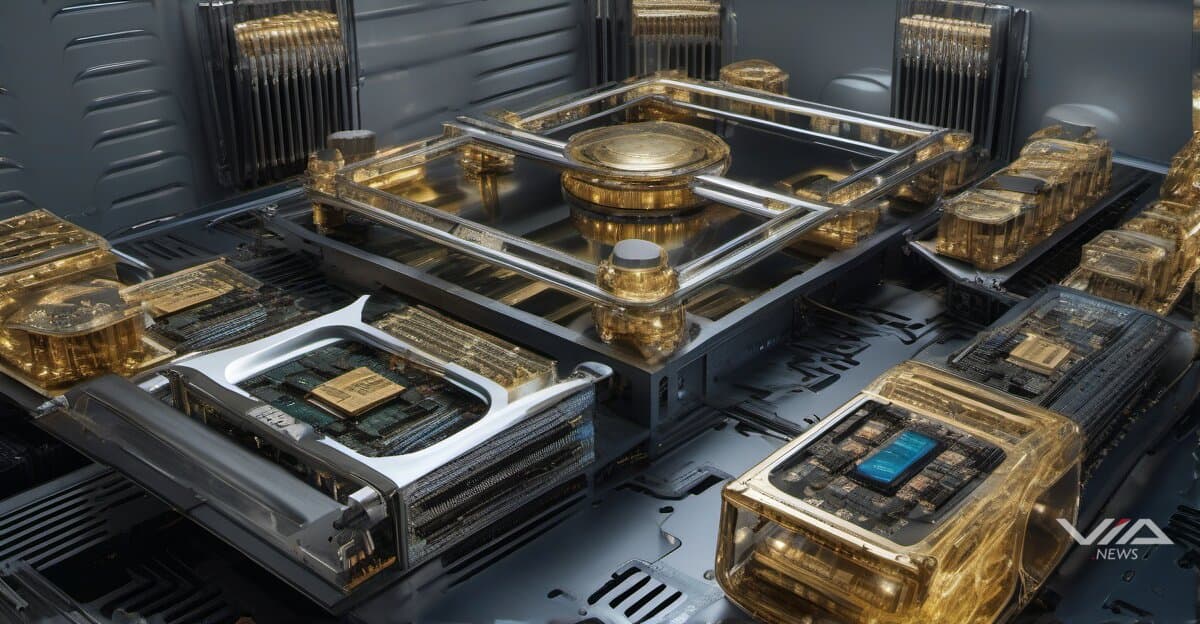
Image generated by AI for illustrative purposes. Not actual footage or photography from the reported events.

Google's Willow quantum chip and Nvidia's AI-assisted error correction work are converging on a capability threshold that threatens the encryption protecting financial systems.1 The two companies are advancing complementary fronts — hardware performance and error correction stability — that together could make cryptographically relevant quantum computing a near-term reality rather than a distant concern.

Current banking encryption relies on RSA and elliptic curve algorithms. Both are secure against classical computers but vulnerable to quantum machines running Shor's algorithm. Willow's launch, paired with an encryption-breaking algorithm under concurrent development, signals the threat is moving from theoretical to actionable.1

Cryptocurrency carries direct exposure. Bitcoin and Ethereum wallets use elliptic curve cryptography. A capable quantum machine could compromise wallets whose public keys have been exposed through prior transactions — a significant share of circulating supply. Markets have not yet priced this risk.

Banks face a broader attack surface. Core banking platforms, SWIFT messaging, interbank settlement rails, and TLS-secured APIs all depend on encryption quantum computing could break. A sudden capability jump would create asymmetric losses for institutions that have not migrated infrastructure.

The immediate danger is not a machine breaking encryption tomorrow. It is harvest-now-decrypt-later attacks: adversaries collecting encrypted financial data today, holding it until quantum capability matures. Every institution transmitting sensitive data over current standards is accumulating that exposure now.

A migration path exists. NIST finalized its first post-quantum cryptography standards in 2024, covering key encapsulation and digital signatures. The obstacle is not standards — it is the multi-year complexity of replacing cryptographic libraries across legacy financial infrastructure at scale.

Regulatory action is the expected next step.1 US and EU financial supervisors have begun incorporating quantum-readiness into operational resilience frameworks. The Alphabet-Nvidia convergence is likely to trigger mandatory audit requirements for systemically important institutions.

For investors, post-quantum cybersecurity vendors are positioned to benefit as institutional demand accelerates. For banks, the cost of delay compounds: migration complexity grows with each year cryptographic debt accumulates.

In this story · Knowledge Files

About this analysis

This is a Via News analysis. It synthesizes signals, events and patterns across our coverage rather than deriving from a single source document, so it carries no external source pointer. Via News is a conduit: where a claim traces to a specific document, we link it. How we source

LM Salvado
LM Salvado

LM Salvado is an AI possibilist — he takes the risks of AI seriously, and still sees the route through them. Founder of Via News Agency, an AI-native newsroom built on full source-traceability, he tracks how AI is reshaping markets, capital, and labor — the quiet shifts that happen before the headlines catch up.

What we know · the intelligence behind this page
Live from the substrate
What we're seeing
Q4 2026 Clinical Catalyst Season: Big-Pharma Data Flow, Regulatory Milestones, and a Thin AI-Drug Fringe
October 2026 conferences (EASD, IGCS, NACFC, HFSA) are producing a dense run of late-stage readouts from Novo Nordisk, Lilly, Roche, Bayer, Vertex and Galderma. Regulatory milestones are scheduled behind them: the ivonescimab BLA PDUFA date on 2026-11-14, FDA acceptance of Roche's vamikibart BLA, and Scholar Rock's EMA resubmission. The AI-and-finance angle is peripheral. It consists of the AI-designed drug Rentosertib and QAIAx, a speculative microcap whose trial claims (the QIII pilot, anticipated 2027-01-01, and a patent update) are forecasts and filings rather than data, so they warrant skepticism.
Our read on the data ›
Signals we're tracking
EPKINLY Regulatory-Clinical Success Cascade
High probability of expanded label indications, additional combination approvals, and competitive positioning strength in follicular lymphoma market. Predicts positive commercial uptake and potential accelerated review for related indications.
Patterns we're watching ›
Where sources disagree
ING Group
Both facts record the same metric (shares_outstanding) for ING Group at the identical observation date (2025-12-31). FACT A states 2,902,437,688 shares; FACT B states 2,902 million shares (2,902,000,000). The difference is 437,688 shares (~0.015%). This is a genuine value conflict, though the discrepancy appears to result from FACT B rounding to the nearest million while FACT A provides the precise count.
We flag conflicts openly ›
Recently verified
✓ Checked against the original source
4,986
facts traced to their source — and we flag the ones that don't hold up.
101 entities tracked4,986 facts checked against source5,375 source documents archived
Query this data → isubstrate.com