
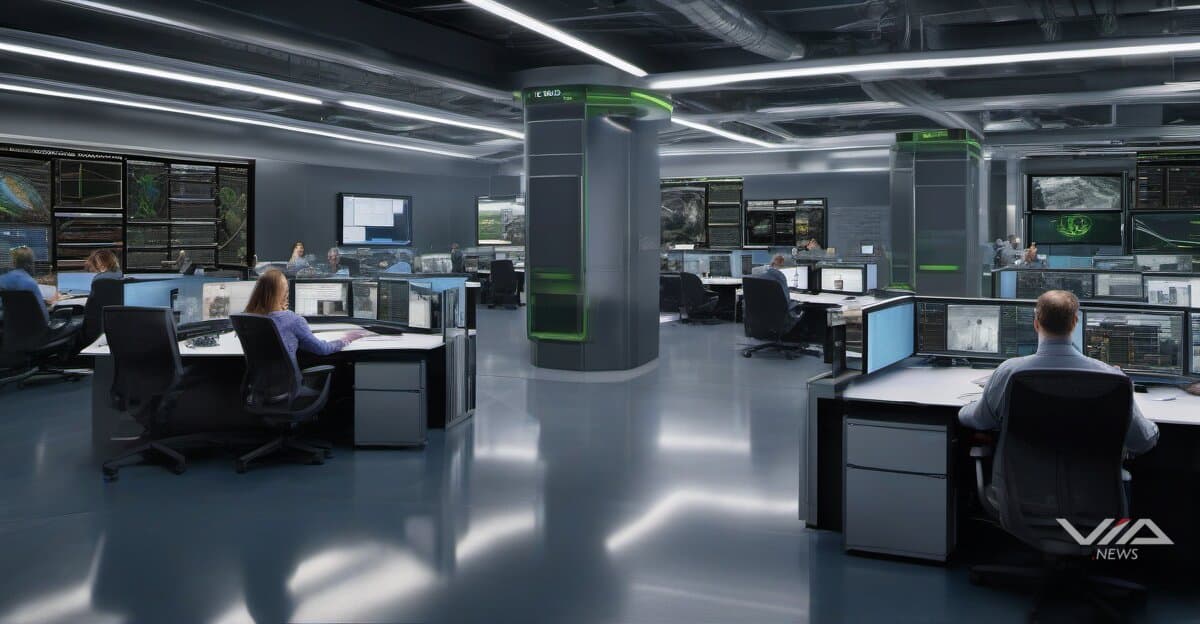
NVIDIA's next-generation GPU architectures are powering a wave of enterprise AI deployments as deep learning transitions from research labs to commercial operations. Companies deployed specialized AI agents across multiple sectors in early 2026, with hardware investments following production needs rather than experimental budgets.
Burger King launched Patty AI for restaurant operations. Perplexity released a Computer agent for enterprise workflows. Rad AI deployed data transformation tools that convert unstructured information into content with measurable ROI metrics. These deployments require dedicated GPU clusters running NVIDIA's Hopper H100 and upcoming Blackwell B200 architectures.
The hardware economics are shifting. Stanford AI Lab research shows training on diverse video datasets—including human demonstrations—improves AI task performance by 20%+ on unseen operations. This finding pushes enterprises toward larger compute investments for better model generalization rather than task-specific training.
Neural network architectures are evolving toward explainability requirements. Autonomous vehicle researchers at IEEE Spectrum identified passenger information delivery as a design challenge, with explanations needed via audio, visualization, or text depending on technical knowledge and age. Analyzing AI decision-making after errors could produce safer systems, according to researcher Shahin Atakishiyev.
Market research confirms deep learning expansion into autonomous systems and robotics beyond traditional enterprise software. The technology now handles real-world physical operations requiring split-second decisions, not just data analysis.
Ethical boundaries are emerging alongside commercial growth. Anthropic refused Pentagon contracts despite competitors accepting defense work, creating a split between AI providers willing to serve military applications and those restricting government deployments. This decision impacts available contract revenue but positions the company for enterprise clients with ethical AI requirements.
The infrastructure investment cycle favors established GPU manufacturers. NVIDIA dominates AI accelerator sales with no viable competitor matching Hopper performance per watt. Enterprise buyers face 6-12 month lead times for H100 clusters, pushing some deployments to cloud providers rather than on-premise installations.
Banking and investment firms are watching GPU supply chains as a proxy for AI adoption rates. Hardware delivery timelines indicate whether enterprises are committing capital to production AI systems or remaining in pilot phases.