
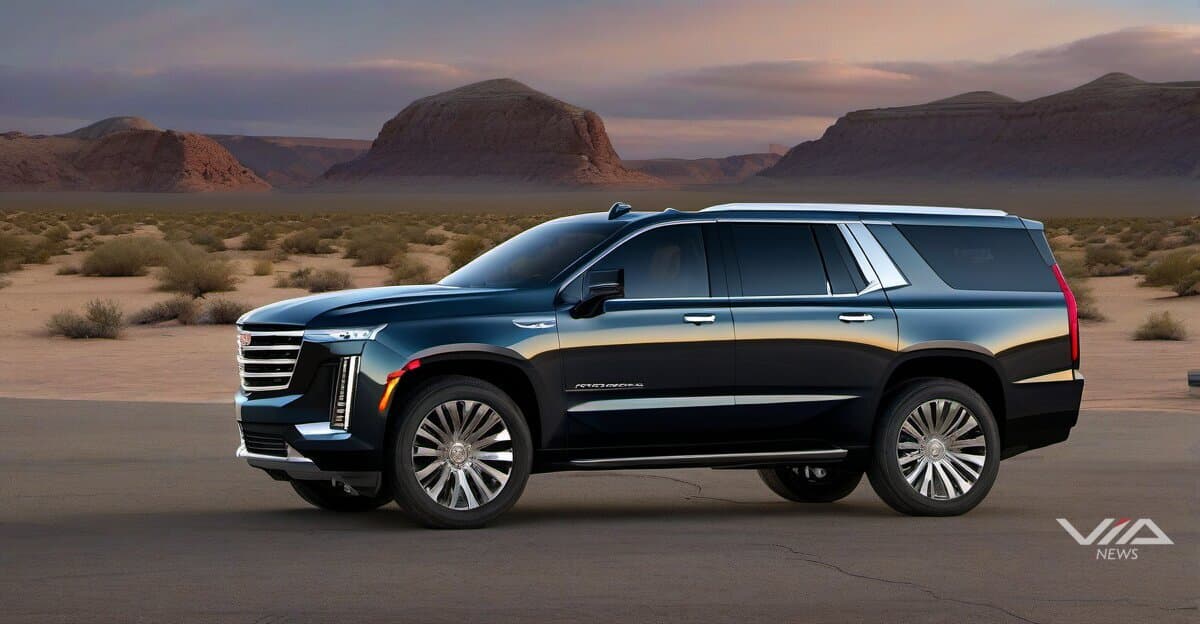
General Motors is making one of the most consequential technology bets in its century-long history. Buried within the company's otherwise robust Q4 2025 earnings report — which posted $12.7 billion in full-year adjusted EBIT and $10.6 billion in free cash flow — was a line item that signals where Detroit's future is being built: up to $1.5 billion earmarked for onshoring and software investment in 2026 alone.
That investment is the financial underpinning of a sweeping architectural transformation. GM has confirmed plans to launch its second-generation software-defined vehicle (SDV) platform in 2028, debuting with the Cadillac Escalade I. The new architecture promises a single unified compute core, over-the-air (OTA) update capacity ten times greater than current systems, and an astonishing 1,000-fold increase in bandwidth. In an industry where vehicles are increasingly differentiated by what they can do after the point of sale, those numbers represent a serious competitive moat.
For investors, the SDV thesis is straightforward: software margins are structurally higher than hardware margins. GM's own guidance for 2026 identifies OnStar and software services as generating $400 million in incremental high-margin revenue — a figure expected to grow substantially as the installed base of connected vehicles expands and the 2028 platform enables richer, more frequent feature deployments.
The strategic logic mirrors what has made Tesla a market darling despite its manufacturing roots. OTA capability transforms a vehicle from a depreciating asset into an upgradeable platform. For GM, which sold vehicles across multiple brands and price points to capture 60 basis points of U.S. market share in 2025, the ability to push software-based performance, safety, and feature upgrades to millions of vehicles simultaneously is a distribution advantage that pure software companies cannot replicate.
The 2026 investment does appear in GM's guidance as a headwind — lumped alongside supply chain and onshoring costs in a $1 to $1.5 billion bucket, split roughly 50/50 between the two categories. CFO Paul Jacobson has been candid that near-term margin compression is the price of the transformation. North America EBIT margins are projected at 8 to 10 percent in 2026, recovering toward historical norms, but the software spend is a deliberate drag on near-term profitability.
That trade-off is being made from a position of financial strength. GM enters 2026 with $21.7 billion in cash, has retired 465 million shares since November 2023 — reducing its diluted share count by 35 percent — and has increased its quarterly dividend by 20 percent to $0.18 per share. A new $6 billion buyback authorization signals management's confidence that the software investment will yield returns without straining the balance sheet.
The competitive context adds urgency to the timeline. Chinese automakers, now accounting for roughly half of GM's China joint venture sales in the new energy vehicle segment, have demonstrated that software integration can accelerate product cycles and deepen customer loyalty. Meanwhile, Ford and Stellantis are pursuing their own SDV roadmaps, making 2028 a pivotal year across the industry.
For GM, the 2028 Escalade launch is not merely a product milestone — it is the opening argument in a long-term case to investors that the company can generate Apple-style recurring software revenue from a Ford-scale manufacturing base. Whether that thesis proves out will depend on execution, consumer adoption, and whether the bandwidth and compute advantages of SDV 2.0 translate into services customers are willing to pay for. The capital has been committed. The clock is running.