
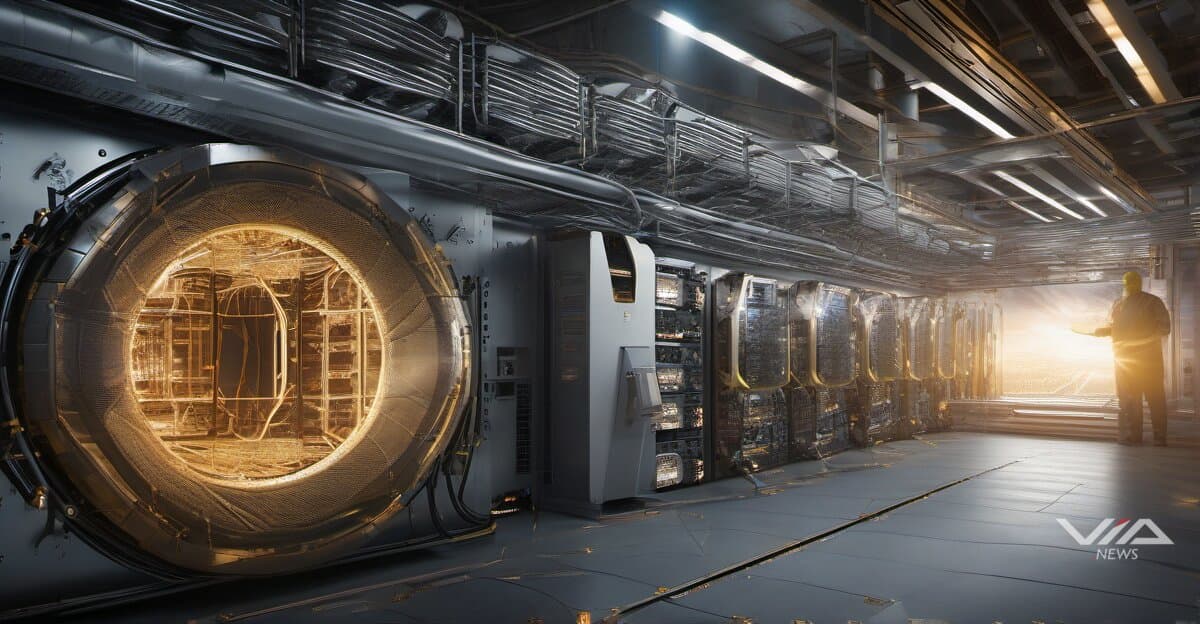
The AI infrastructure buildout is forcing companies to rethink power, connectivity, and security systems as traditional data center designs reach capacity limits.
Offshore wind-powered underwater data centers are entering deployment to address energy and cooling constraints. The marine environment introduces engineering challenges including increased salinity, debris, and corrosion of metal piping not present in freshwater systems, according to Daniel King's technical assessment.
Nokia is advancing AI-RAN technology to enable distributed intelligence across network layers. "Physical AI requires an intelligent network underpinned by AI-RAN so operators can fully harness distributed intelligence across every layer of the network," said Ronnie Vasishta.
Chip manufacturers are shipping 4nm interconnects designed specifically for AI workloads. These AI-Scale Ethernet technologies address bandwidth bottlenecks in multi-GPU training clusters and inference systems.
Supermicro is expanding its portfolio of Red Hat-certified systems for AI factories. Vik Malyala stated the company is "dedicated to delivering the most advanced accelerated computing infrastructure for AI factories" with validated solutions combining high-performance systems and enterprise-grade software platforms.
Security architecture is evolving to accommodate AI agent deployments. Veea Inc. released Lobster Trap, an open-source scanning system that operates under one millisecond with no meaningful delay. The company claims this enables organizations to accelerate updates and deploy new capabilities without compromising system stability.
Veea also launched TerraFabric, designed to operate AI and autonomous systems at the edge. Based on large-scale deployments, the platform allows faster capability rollouts while maintaining stability.
Red Hat partnered with NVIDIA to create AI Factory infrastructure that simplifies deployment and scaling of mission-critical AI workloads. The collaboration aims to reduce time-to-value and deliver predictable operations across hybrid cloud environments.
The infrastructure shift represents a departure from adapting existing systems to building AI-native platforms from the ground up. Companies are engineering purpose-built solutions across power generation, network architecture, and operational security rather than retrofitting legacy infrastructure.
This capital deployment pattern indicates organizations view AI infrastructure as a foundational investment requiring specialized components rather than incremental upgrades to existing facilities.