

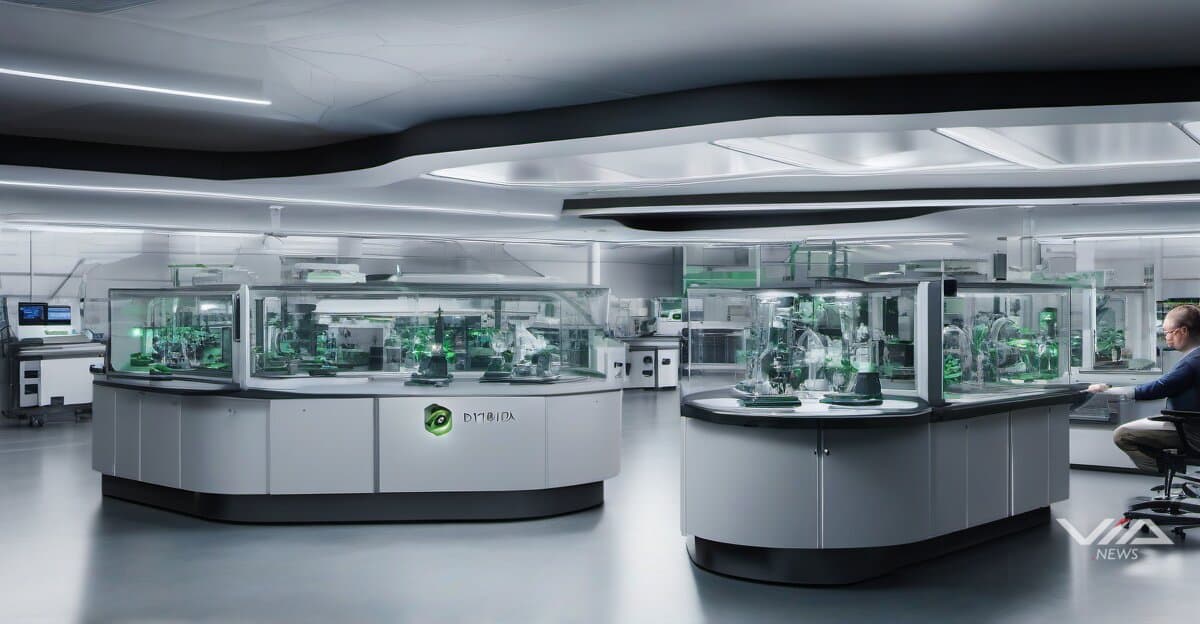
NVIDIA's BioNeMo platform has been adopted by major pharmaceutical companies Eli Lilly and Thermo Fisher Scientific to accelerate AI-driven drug discovery.1 The partnerships establish NVIDIA as the foundational infrastructure provider for computational biology as the industry shifts toward AI-native research workflows.
Five biotech AI companies—Natera, Basecamp Research, Owkin, Edison Scientific, and Boltz Lab—launched foundation model platforms in recent months, all relying on NVIDIA's technology stack.1 The simultaneous rollouts indicate coordinated infrastructure buildout across the sector rather than isolated experiments.
BioNeMo provides pre-trained AI models for protein structure prediction, molecular generation, and genomic analysis. Pharmaceutical companies can customize these models for proprietary drug discovery programs without building AI infrastructure from scratch. Thermo Fisher will integrate BioNeMo into laboratory automation systems, while Lilly plans to deploy the platform across early-stage drug development.
The strategic value lies in speed and cost reduction. Traditional drug discovery takes 10-15 years and costs over $2 billion per approved medication. AI models can screen millions of molecular compounds in weeks, identifying candidates for laboratory testing far earlier in the development cycle.
For investors, NVIDIA's positioning mirrors its data center strategy: provide the infrastructure layer that captures value regardless of which biotech applications succeed. As pharmaceutical companies compete on AI capabilities, demand for NVIDIA's GPUs and specialized biotech software creates recurring revenue independent of individual drug outcomes.
The biotech AI buildout differs from consumer AI adoption patterns. Pharmaceutical companies face regulatory requirements for model transparency and validation that favor established infrastructure providers over startups. NVIDIA's partnerships with industry leaders like Lilly signal that major drugmakers will standardize on proven platforms rather than risk compliance issues with unvetted alternatives.
The timing aligns with patent cliffs facing major pharmaceutical companies in 2026-2028. Blockbuster drugs losing exclusivity will pressure R&D productivity, making AI acceleration strategically necessary rather than experimental. NVIDIA's early partnerships position the company to capture infrastructure spending as the industry shifts research budgets toward computational methods.