
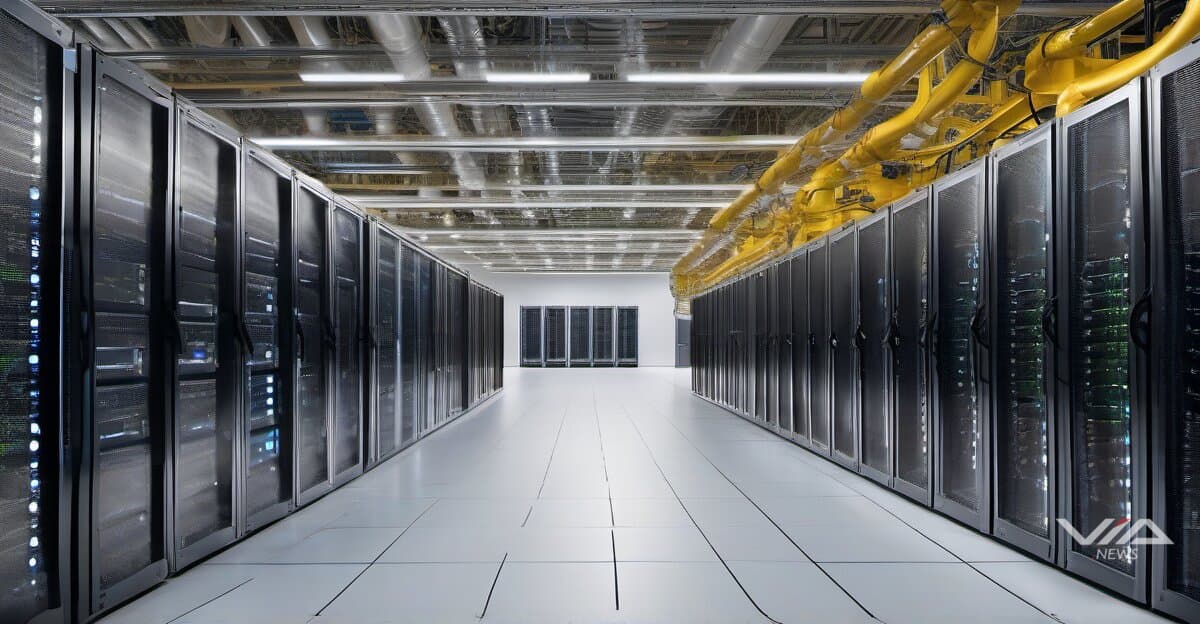
The artificial intelligence boom is driving what may become the largest infrastructure buildout in corporate history, with networking, storage, and data center capacity emerging as critical bottlenecks—and trillion-dollar investment opportunities—for companies positioning themselves at the foundation of AI compute.
Cisco's latest Silicon One G300 chip launch underscores the urgency. Designed to deliver breakthrough 1.6 terabit scale-out performance in the company's N9000 series switches, the G300 represents a fundamental architectural shift. "At AI-factory scale, performance is no longer determined by the network or the data layer alone—it's defined by how tightly they work together," said Sven Oehme, Cisco's CTO for AI infrastructure. The move toward open, standards-based networking reflects investor demand for interoperable systems that can scale across heterogeneous environments, reducing vendor lock-in risk in multi-billion-dollar deployments.
The financial stakes are staggering. Industry forecasts project the global data center market reaching trillion-dollar valuations within the decade, driven by multi-gigawatt GPU partnerships and hyperscale AI training clusters. This capital intensity is forcing unlikely players into the infrastructure game. CleanSpark, previously focused on bitcoin mining, announced plans to redeploy cash flows from its scaled mining operations into "long-duration infrastructure opportunities." CFO Matt Schultz emphasized the strategy is "being funded from a position of strength," with durable mining cash flows now targeting infrastructure assets expected to "drive significant shareholder value over time."
Similarly, Bitfarms is rebranding as Keel Infrastructure, with CEO Ben Gagnon describing the company's evolution using maritime metaphor: "The keel is the structural backbone of a vessel—the largely unseen but critical foundation that provides stability and converts energy into forward motion." The messaging signals a broader industry recognition that AI infrastructure—power distribution, cooling systems, high-bandwidth networking—represents defensible, capital-intensive moats that align with institutional investor preferences for long-term asset plays.
Yet this infrastructure arms race faces mounting friction. Regulatory tensions between the Pentagon and AI labs over chipmaker supply chains, local opposition to energy-intensive data center construction, and semiconductor litigation involving Russian weapons systems all introduce execution risk into what is otherwise a bullish expansion trajectory. Energy demands alone pose systemic constraints: multi-gigawatt facilities require utility partnerships, permitting timelines measured in years, and community acceptance increasingly difficult to secure.
For investors, the divergence is clear. Companies offering pick-and-shovel infrastructure—networking fabric, storage arrays, colocation capacity—are attracting capital at premium valuations, while those lacking clear positioning in the physical AI stack face compression. As Cisco's Yousuf Khan noted, "AI at scale demands open, standards-based networking that customers can deploy with confidence across diverse environments." That confidence, increasingly, is what separates fundable infrastructure from speculative technology bets in a market where trillion-dollar forecasts demand trillion-dollar foundations.