
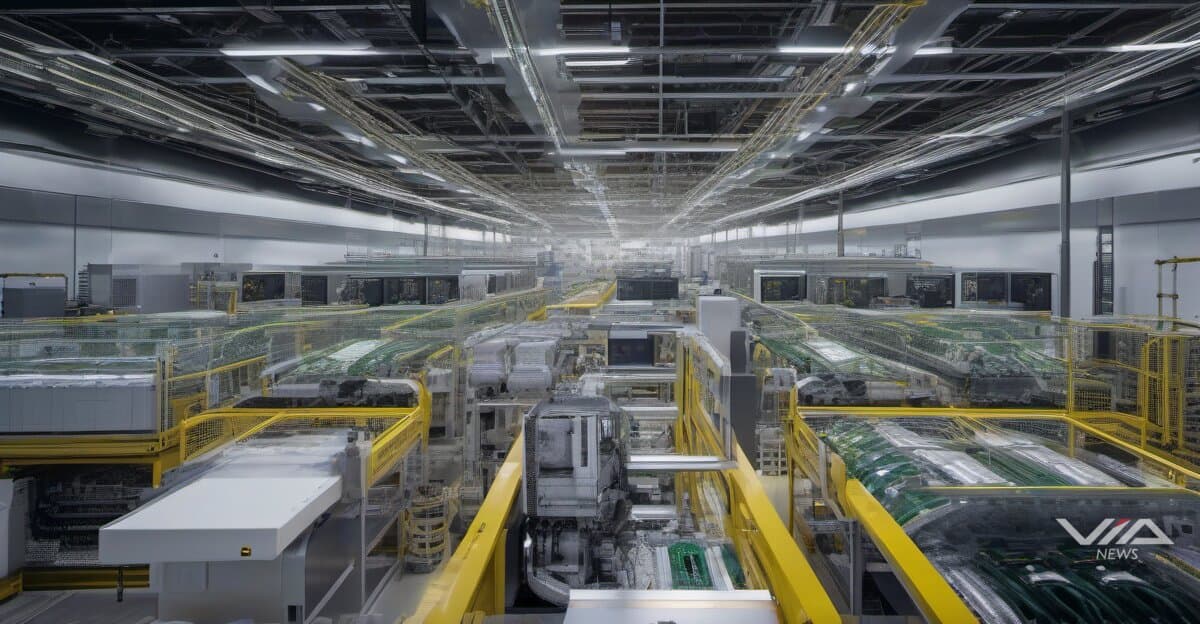
Nvidia allocated $4 billion to silicon photonics partnerships with Coherent and Lumentum, marking a major capital deployment to solve interconnect bandwidth constraints in AI data centers. The investment targets optical communication technologies that transmit data using light rather than electrical signals.
Traditional copper-based interconnects cannot sustain the data transfer speeds required by next-generation AI accelerators. Silicon photonics enables higher bandwidth and lower latency between processors, addressing a critical infrastructure gap as companies deploy larger AI models.
The semiconductor supply chain is responding to sustained AI infrastructure spending. Analog Devices reported strong demand from industrial and data center customers as AI deployment continues. Lattice Semiconductor issued Q1 revenue guidance of $158 million to $172 million, reflecting robust order books.
Data center operators face mounting pressure to upgrade physical infrastructure as AI workloads consume more power and generate exponentially more data. Optical interconnects reduce energy consumption per bit transmitted compared to copper alternatives, lowering operational costs at scale.
The silicon photonics market benefits from Nvidia's dual role as customer and investor. By funding supplier capacity expansion, Nvidia secures future component supply while accelerating technology development cycles. Coherent and Lumentum gain capital to build manufacturing capacity ahead of demand.
SiTime Corporation's acquisition of Renesas' timing business demonstrates ongoing consolidation in specialty semiconductor segments. The deal is expected to be accretive to earnings in the first year, indicating healthy profit margins in components serving data center applications.
Corporate investment patterns suggest companies view AI infrastructure as a multi-year growth cycle rather than a short-term trend. Capital commitments to specialized components like silicon photonics and precision timing devices indicate deepening technology requirements as AI systems scale.
The shift toward optical interconnects represents a structural change in data center architecture. Companies that control critical components in the AI infrastructure stack are attracting strategic investments from hyperscalers and chip makers seeking to secure supply chains.