
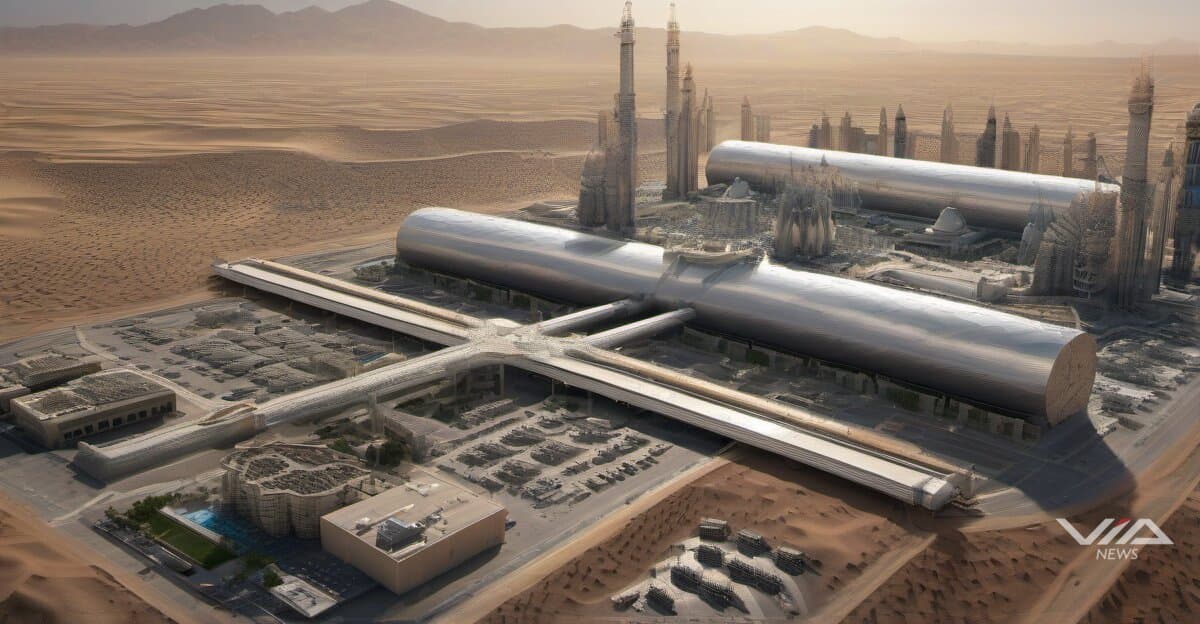
Saudi Arabia announced more than $15 billion in AI infrastructure investments across four major technology partnerships within 30 days, signaling an aggressive push to establish the kingdom as a third global AI compute hub outside the US-China axis.
The investment cluster includes deals with Amazon Web Services, Google Cloud, AMD, and Nvidia. Most notably, Saudi officials repurposed The Line—the linear desert megacity project plagued by cost overruns and engineering challenges—into a planned AI data center complex.
The pivot addresses two problems simultaneously. The Line had faced mounting criticism over its $1 trillion price tag and questionable feasibility as a residential project. Converting the infrastructure to AI computing facilities salvages sunk costs while positioning Saudi Arabia in the AI infrastructure race.
Cloud providers are backing the shift with capital commitments. AWS and Google Cloud are establishing regional data center capacity, while AMD and Nvidia are supplying advanced chips despite ongoing global semiconductor allocation pressures.
The timing reflects broader geopolitical competition for AI sovereignty. Nations increasingly view AI compute capacity as strategic infrastructure, similar to oil reserves or electrical grids. Saudi Arabia's oil wealth provides capital advantages that smaller economies lack.
For enterprise investors, the concentration of deals suggests three near-term implications. First, MENA region AI adoption will likely accelerate within 6-12 months as local cloud infrastructure comes online. Second, competition for AI chip supply may intensify as sovereign projects claim allocations previously earmarked for commercial customers. Third, sovereign AI initiatives could reshape hyperscaler expansion strategies beyond traditional Western markets.
The financial commitment represents roughly 1.5% of Saudi Arabia's sovereign wealth fund assets. For comparison, Microsoft invested $13 billion in OpenAI over multiple years. Saudi Arabia is deploying comparable capital in weeks, not years.
Risk factors include execution challenges in rapidly scaling data center operations and uncertainty around local AI talent pipelines. However, the capital commitment and vendor partnerships create structural advantages that differentiate this effort from previous tech hub initiatives in the region.
The shift from The Line's urban vision to AI infrastructure marks a pragmatic recalibration. Rather than building cities for future residents, Saudi Arabia is building compute capacity for current demand.