
Wednesday, October 14, 2026

AMD Lands Double-Digit Billion Dollar Meta Contract as Hyperscalers Cut AI Infrastructure Costs

Meta awarded AMD a data center GPU contract valued at double-digit billions per gigawatt, driving AMD shares up 7%. The deal signals cost optimization is reshaping competition in AI infrastructure, where hyperscalers face trillion-dollar buildout expenses.

AMD Lands Double-Digit Billion Dollar Meta Contract as Hyperscalers Cut AI Infrastructure Costs
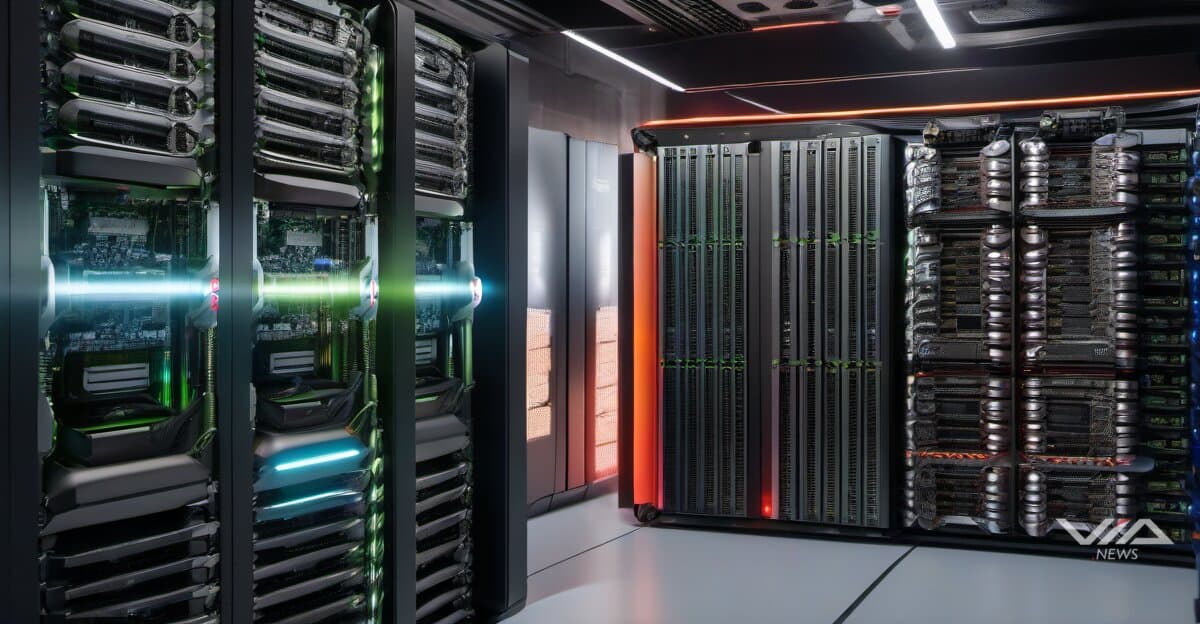
Image generated by AI for illustrative purposes. Not actual footage or photography from the reported events.

Meta awarded AMD a data center GPU contract worth double-digit billions of dollars per gigawatt, sending AMD shares up 7% on the announcement. The contract marks a major enterprise win for AMD against dominant competitor NVIDIA in AI infrastructure hardware.

Cost pressures are driving the shift. AI infrastructure represents the largest buildout in human history with trillions in cumulative investment required, according to networking firm Netris. Hyperscale cloud providers are scrutinizing GPU economics as they expand capacity to meet AI compute demand.

AMD's pricing advantage is opening doors at the largest data center operators. The company has positioned its MI300 series accelerators as cost-effective alternatives to NVIDIA's H100 and H200 chips, which command premium prices due to market dominance. Meta's contract suggests AMD's performance-per-dollar proposition is winning evaluations at scale.

The Asia-Pacific region is among the fastest-expanding markets for AI infrastructure deployment, according to VCI Global Limited analysis. This geographic expansion creates additional opportunities for AMD to capture market share as new facilities evaluate vendor options without legacy NVIDIA commitments.

AMD's data center segment will provide visibility into market share gains over the next 2-3 quarters. Analysts expect additional hyperscaler contract announcements as cost optimization becomes a strategic priority. The Meta deal establishes AMD as a credible second source for AI accelerators at enterprise scale.

GPU pricing dynamics are shifting. NVIDIA maintained 80%+ market share in data center accelerators through 2023, but supply constraints and premium pricing created openings for competition. AMD's ability to deliver compatible software stacks and competitive performance metrics is reducing switching costs for large deployments.

The Meta contract validates AMD's data center strategy and signals vendor diversification among top-tier cloud providers. As AI infrastructure spending continues multi-year expansion, cost efficiency is emerging as a decisive factor in procurement decisions worth tens of billions annually.

In this story · Knowledge Files

What we know · the intelligence behind this page
Live from the substrate
What we're seeing
Q4 2026 Clinical Catalyst Season: Big-Pharma Data Flow, Regulatory Milestones, and a Thin AI-Drug Fringe
October 2026 conferences (EASD, IGCS, NACFC, HFSA) are producing a dense run of late-stage readouts from Novo Nordisk, Lilly, Roche, Bayer, Vertex and Galderma. Regulatory milestones are scheduled behind them: the ivonescimab BLA PDUFA date on 2026-11-14, FDA acceptance of Roche's vamikibart BLA, and Scholar Rock's EMA resubmission. The AI-and-finance angle is peripheral. It consists of the AI-designed drug Rentosertib and QAIAx, a speculative microcap whose trial claims (the QIII pilot, anticipated 2027-01-01, and a patent update) are forecasts and filings rather than data, so they warrant skepticism.
Our read on the data ›
Signals we're tracking
EPKINLY Regulatory-Clinical Success Cascade
High probability of expanded label indications, additional combination approvals, and competitive positioning strength in follicular lymphoma market. Predicts positive commercial uptake and potential accelerated review for related indications.
Patterns we're watching ›
Where sources disagree
ING Group
Both facts record the same metric (shares_outstanding) for ING Group at the identical observation date (2025-12-31). FACT A states 2,902,437,688 shares; FACT B states 2,902 million shares (2,902,000,000). The difference is 437,688 shares (~0.015%). This is a genuine value conflict, though the discrepancy appears to result from FACT B rounding to the nearest million while FACT A provides the precise count.
We flag conflicts openly ›
Recently verified
✓ Checked against the original source
4,986
facts traced to their source — and we flag the ones that don't hold up.
101 entities tracked4,986 facts checked against source5,375 source documents archived
Query this data → isubstrate.com