
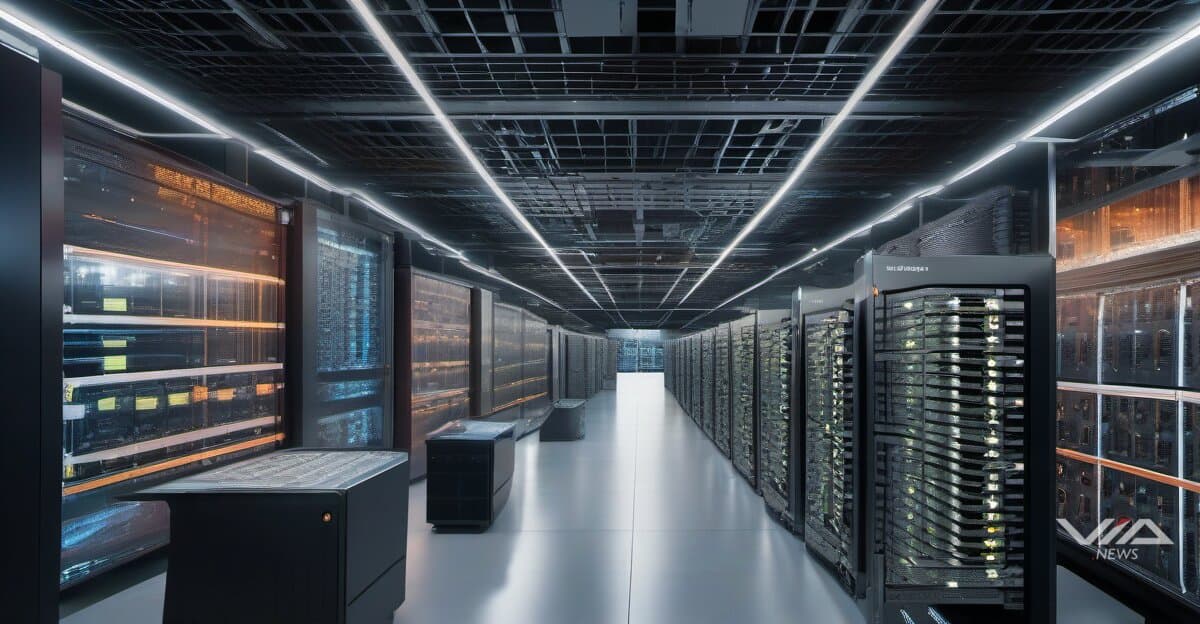
Meta expanded AI data center capital expenditures in 2026, joining a broader infrastructure buildout among major technology companies targeting enterprise AI deployment.
Cisco and AMD released new hardware platforms: Cisco shipped next-generation networking equipment for AI workloads while AMD delivered updated GPU software tools. The releases address enterprise demand for deep learning infrastructure spanning training and inference.
Research teams achieved 20%+ performance improvements on unseen tasks by training models on human video datasets rather than synthetic data alone, according to Stanford AI Lab. The finding impacts foundation model development costs and generalization capabilities.
Neural network architecture research advanced through TAPINN development and Kolmogorov-Arnold Network evaluations. Both approaches target training efficiency and model interpretability for enterprise applications.
Enterprise adoption expanded across three verticals. Autonomous vehicle developers integrated explainable AI systems to justify real-time driving decisions to passengers and regulators. Medical imaging providers deployed deep learning vision systems for diagnostic workflows. Trading firms implemented foundation models for market analysis and execution.
The autonomous vehicle sector faces passenger communication challenges. "Explanations can be delivered via audio, visualization, text, or vibration, and people may choose different modes depending on their technical knowledge, cognitive abilities, and age," said Shahin Atakishiyev in IEEE Spectrum. Post-incident analysis of decision-making processes aims to improve safety protocols.
Stanford researchers developed DVD (Domain-Agnostic Video Discriminator), trained on mixed robot and human video datasets. The system achieved 20%+ higher success rates on unseen environments compared to robot-only training data. The work builds on earlier LOReL (Language-conditioned Offline Reward Learning) research combining DistilBERT with Visual Model-Predictive Control for a 66% success rate on language-specified tasks.
Hardware standardization centered on platforms including Franka Emika Panda robots for manipulation tasks. Training datasets incorporated Something-Something human video collections and YouTube demonstrations alongside proprietary robot interaction episodes.
The infrastructure investments support enterprise migration from proof-of-concept projects to production deep learning deployments across the AI stack.