
Wednesday, October 14, 2026

Duke Energy's $103B Capex Plan Shows AI Power Demand Is Rewriting Utility Budgets

Duke Energy has committed to a $103B five-year capital expenditure program anchored by electricity supply agreements with major hyperscalers, with its CEO signaling the figure will increase. The plan includes next-generation nuclear power, reflecting hyperscaler demand for continuous baseload-grade electricity. AI infrastructure buildout has now grown large enough to structurally reshape utility capital allocation across the sector.

LM Salvado
LM Salvado

April 27, 2026

Duke Energy's $103B Capex Plan Shows AI Power Demand Is Rewriting Utility Budgets
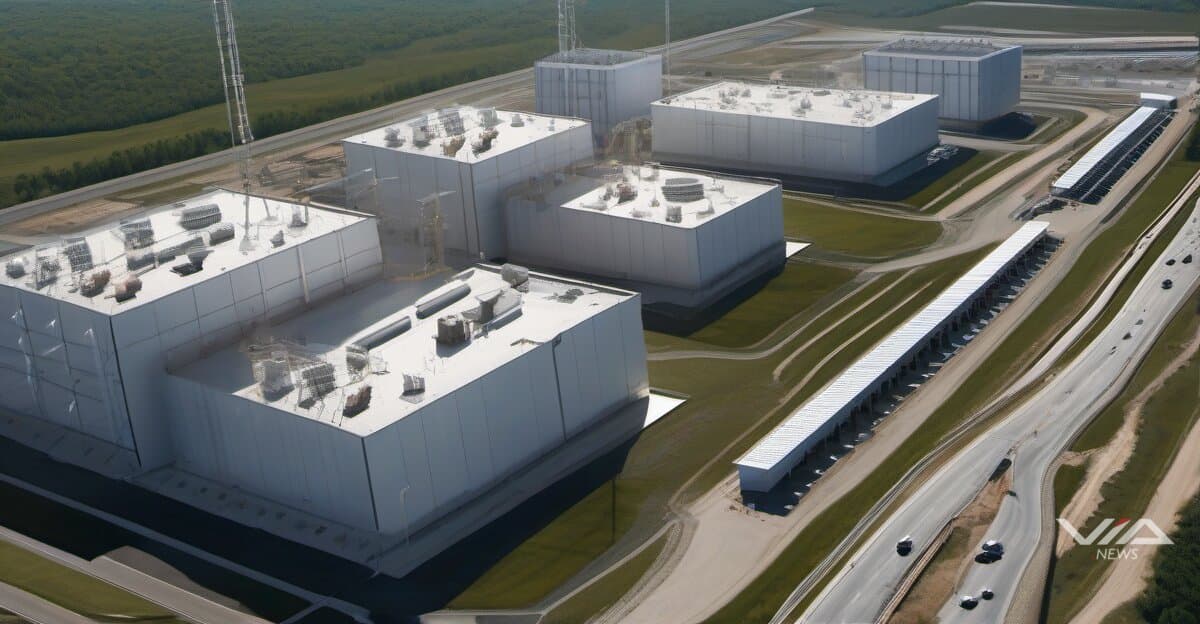
Image generated by AI for illustrative purposes. Not actual footage or photography from the reported events.

Duke Energy is deploying a billions five-year capital expenditure plan, driven by electricity supply agreements signed with major hyperscalers building AI data centers.1 The company's CEO has explicitly signaled that number will grow.

The utility is locking in long-term power contracts to supply data centers at scale. That shift is moving AI infrastructure costs onto regulated utility balance sheets — and into rate base calculations that affect every ratepayer in Duke's service territory.

Duke's inclusion of next-generation nuclear power in its forward plan is the sharpest signal in the announcement.1 Hyperscalers need 24/7 baseload electricity. Renewables without storage cannot guarantee that profile. Nuclear can. Utilities integrating nuclear into long-range plans are positioning to retain hyperscaler load commitments that may span decades.

The capital allocation pressure is not limited to Duke. Utilities across major data center corridors — where land, fiber, and transmission capacity intersect — face the same dynamic: absorb accelerating load growth now, or lose hyperscaler siting decisions to competing territories. The result is a capex supercycle concentrated in a handful of service areas.

For equity investors, two linked opportunities emerge. First, utilities in hyperscaler-dense territories stand to expand their regulated rate base on the back of guaranteed long-term load growth — a direct path to earnings expansion within a regulated return framework. Second, nuclear energy equities are seeing renewed institutional interest after years of stagnation, as both hyperscalers and utilities signal long-term demand for baseload-grade generation.1

Execution risk is real. A billions capex program requires sustained capital markets access, regulatory approval for cost recovery, and on-schedule project delivery. Utilities have historically struggled with large infrastructure programs on all three dimensions. Duke's CEO flagging further upside to the plan signals confidence in demand visibility — but confidence and delivery are different things.

AI compute infrastructure has now crossed the threshold where its power requirements are large enough to move utility sector fundamentals. Duke's announcement is the clearest single data point yet that hyperscaler demand has become a structural driver of utility capital allocation — not a cyclical tailwind.

Investors watching for correlated demand should monitor AI-adjacent hardware categories: liquid cooling systems, high-voltage power management equipment, and data center networking infrastructure. Each scales with the same buildout driving Duke's capex expansion.

About this analysis

This is a Via News analysis. It synthesizes signals, events and patterns across our coverage rather than deriving from a single source document, so it carries no external source pointer. Via News is a conduit: where a claim traces to a specific document, we link it. How we source

LM Salvado
LM Salvado

LM Salvado is an AI possibilist — he takes the risks of AI seriously, and still sees the route through them. Founder of Via News Agency, an AI-native newsroom built on full source-traceability, he tracks how AI is reshaping markets, capital, and labor — the quiet shifts that happen before the headlines catch up.

What we know · the intelligence behind this page
Live from the substrate
What we're seeing
Q4 2026 Clinical Catalyst Season: Big-Pharma Data Flow, Regulatory Milestones, and a Thin AI-Drug Fringe
October 2026 conferences (EASD, IGCS, NACFC, HFSA) are producing a dense run of late-stage readouts from Novo Nordisk, Lilly, Roche, Bayer, Vertex and Galderma. Regulatory milestones are scheduled behind them: the ivonescimab BLA PDUFA date on 2026-11-14, FDA acceptance of Roche's vamikibart BLA, and Scholar Rock's EMA resubmission. The AI-and-finance angle is peripheral. It consists of the AI-designed drug Rentosertib and QAIAx, a speculative microcap whose trial claims (the QIII pilot, anticipated 2027-01-01, and a patent update) are forecasts and filings rather than data, so they warrant skepticism.
Our read on the data ›
Signals we're tracking
EPKINLY Regulatory-Clinical Success Cascade
High probability of expanded label indications, additional combination approvals, and competitive positioning strength in follicular lymphoma market. Predicts positive commercial uptake and potential accelerated review for related indications.
Patterns we're watching ›
Where sources disagree
ING Group
Both facts record the same metric (shares_outstanding) for ING Group at the identical observation date (2025-12-31). FACT A states 2,902,437,688 shares; FACT B states 2,902 million shares (2,902,000,000). The difference is 437,688 shares (~0.015%). This is a genuine value conflict, though the discrepancy appears to result from FACT B rounding to the nearest million while FACT A provides the precise count.
We flag conflicts openly ›
Recently verified
✓ Checked against the original source
4,986
facts traced to their source — and we flag the ones that don't hold up.
101 entities tracked4,986 facts checked against source5,375 source documents archived
Query this data → isubstrate.com